Secondary maths tutoring programmes
Secure strong Year 7 foundations and boost GCSE maths outcomes with Skye, the AI maths tutor built by maths teachers
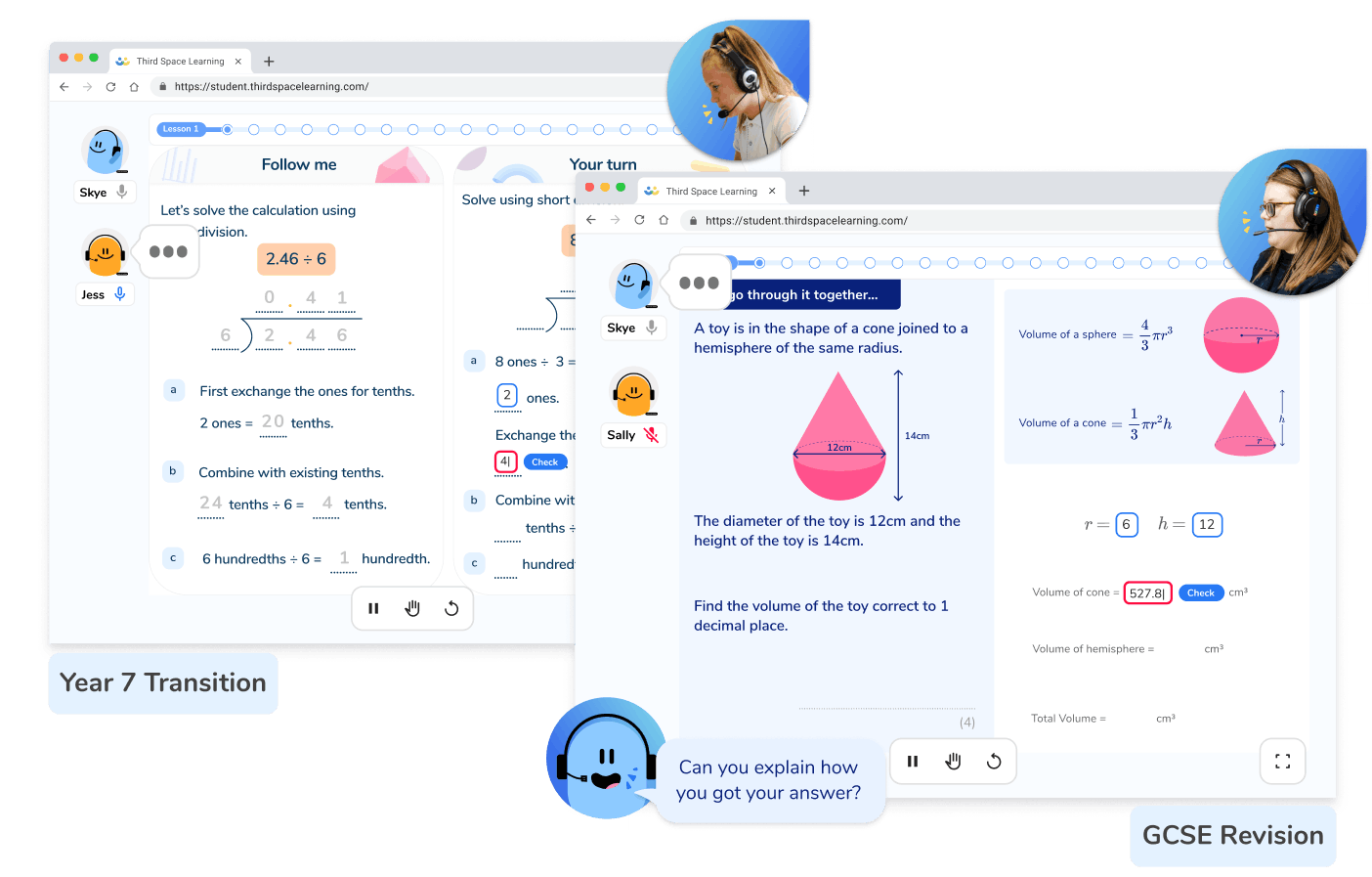
Personalised online one-to-one maths tutoring for Year 7 and GCSE students
Voice-based AI tutoring for secondary maths students
Unlimited sessions and students for just £5,000 per school per year
Year 7 transition and GCSE grades 3–7 programmes
Structured, scaffolded lessons designed by teachers
Flexible scheduling plus on-demand practice
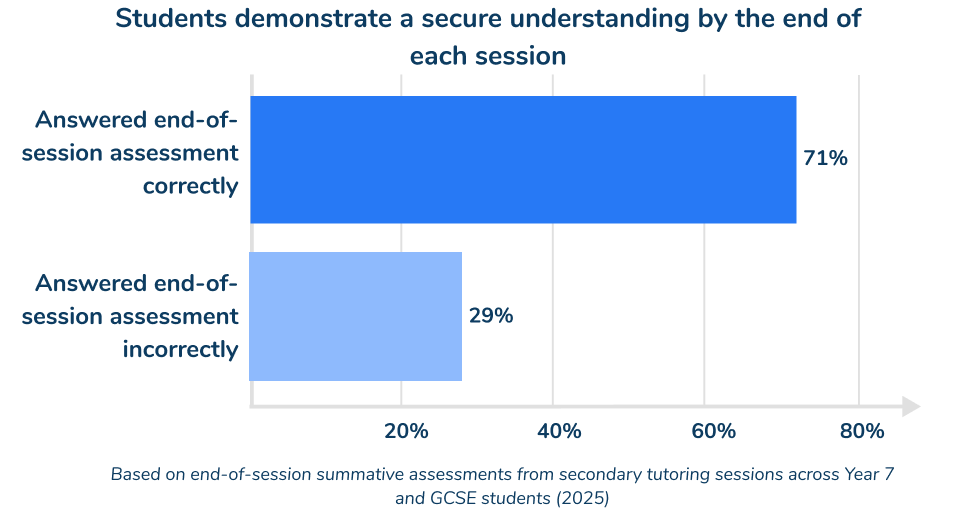
“What’s stood out most is how well it works across the full ability range. Higher attainers find it challenging, middle attainers can work confidently through the content, and lower attainers, who often struggle most with maths, are supported without feeling overwhelmed.
Skye is reliable, bespoke, and it provides meaningful support that makes it easier for us to provide personalised support.”

Nicola Caldwell, Deputy Headteacher
The Salesian Academy of St John Bosco
How secondary maths tutoring works with skye
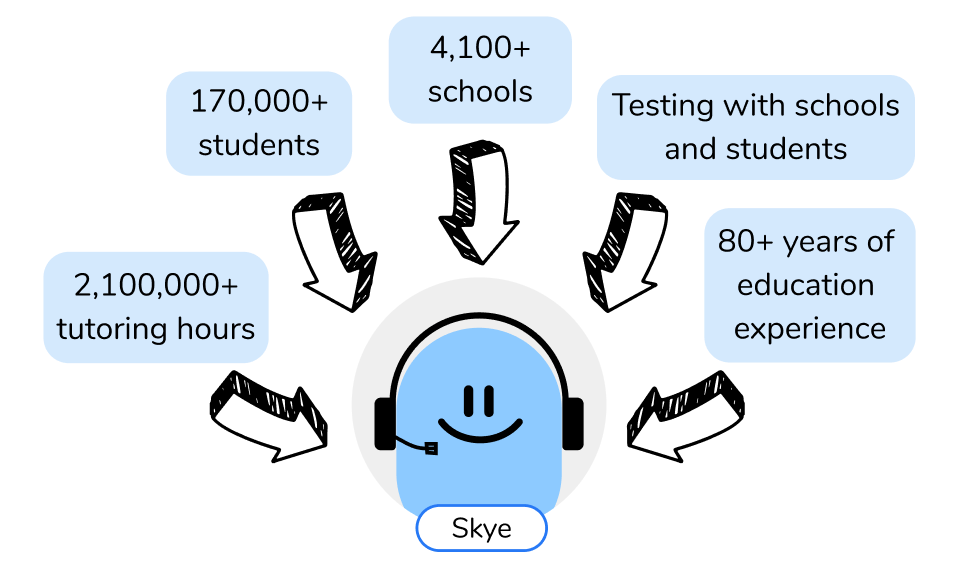
Built on 12 years of school-based tutoring and feedback from secondary teachers, Skye teaches like a secondary maths specialist, but for a fraction of the cost.
This isn’t a generic chatbot. Through structured, dialogue-driven tutoring aligned to KS3 and GCSE, Skye listens, questions and adapts in real time to build fluency and exam confidence.
How it works in schools like yoursFlexible secondary maths tutoring programmes
A range of AI maths tutoring programmes to meet your students’ needs:
Programmes to help meet each student’s target GCSE maths grade
A programme to strengthen core maths knowledge in Year 7
Re-order lessons to align with maths teaching goals:
Pre-teaching
Aligning with current class teaching
Revisiting concepts
Prioritising individual gaps
Year 7 Transition
View lessons

Year 7 Transition
Learning objectives in this programme
All programmes begin with a diagnostic assessment to identify gaps
Partitioning numbers up to 10,000,000
Knowing the value of each digit in numbers with up to 3 decimal places
Comparing and ordering numbers with up to 3 decimal places
Multiplying and dividing whole numbers and decimals by 10 and 100
Rounding numbers to 2 decimal places
Using a number line to calculate across zero
Using mental methods to add and subtract whole numbers and decimals
Adding whole numbers and decimals using the column method
Subtracting whole numbers and decimals using the column method
Finding prime numbers
Finding square numbers
Using mental strategies to multiply
Using mental strategies to divide
Multiplying using short multiplication
Dividing using short division with exchange
Finding equivalent fractions
Simplifying fractions by finding common factors
Adding and subtracting fractions including mixed numbers
Finding percentages of amounts
About this programme
The programme includes high-impact topics on number, calculations and fractions, each carefully crafted to cover the key concepts and skills in these areas essential for moving to Year 7.
How are lessons ordered?
The default order has been set by our academic team for the most appropriate sequence of learning as students develop skills. Teachers can re-order lessons at any point.
Targeting GCSE Grade 3
View lessons
Targeting GCSE Grade 3
Learning objectives in this programme
Each Learning Objective covers a series of GCSE-style questions, progressively building fluency, accuracy, and confidence.
Identifying Types of Number
Understanding Fractions
Working with Powers, Squares, Cubes and Roots
Calculating with Negative Numbers
Identifying Coordinates and Midpoints
Working with Sequences
Identifying Properties of 2D and 3D shapes
Performing Transformations of Shapes
Simplifying and Collecting Like Terms
Drawing and Interpreting Charts and Tables
Converting between Measures
Calculating Averages and Range
Working with Probabilities
Calculating with Fractions
Rounding Values
Finding the HCF and LCM using listing methods
Calculating Percentages
Finding Area and Circumference of Circles
Working with Substitution
Solving Linear Equations
Calculating with Fractions in Context
Working with Fractions, Decimals and Percentages
Drawing a Linear Graph from a Table of Values
Drawing and Interpreting Scatter Graphs
Expanding and Factorising Single Brackets
About this programme
25 high impact topics, each carefully crafted to cover key concepts and skills essential for achieving a Grade 3 in maths. These targeted exercises not only strengthen foundational knowledge but also familiarise students with the format and challenge level of the GCSE, ensuring they feel well-prepared and self-assured for the exam.
How are lessons ordered?
The default order has been set by our academic team for the most appropriate sequence of learning as students develop skills. Teachers can re-order lessons at any point.
Targeting GCSE Grade 4
View lessons
Targeting GCSE Grade 4
Learning objectives in this programme
Each Learning Objective covers a series of GCSE-style questions, progressively building fluency, accuracy, and confidence.
Simplifying and Collecting Like Terms
Drawing and Interpreting Charts and Tables
Converting between Measures
Calculating Averages and Range
Working with Probabilities
Calculating with Fractions
Rounding Values
Finding the HCF and LCM using listing methods
Calculating Percentages
Finding Area and Circumference of Circles
Working with Substitution
Solving Linear Equations
Calculating with Fractions in Context
Working with Fractions, Decimals and Percentages
Drawing a Linear Graph from a Table of Values
Drawing and Interpreting Scatter Graphs
Expanding and Factorising Single Brackets
Using Pythagoras’ Theorem
Using Index Laws
Finding Angles in Parallel Lines
Working with Inequalities
Working with Prime Factorisation
Working with Arithmetic Sequences
Calculating Probability
Solving Area and Perimeter Problems
Calculating Volume
Calculating Surface Area
Working with Ratio
Expanding Double Brackets
Calculating Averages from Tables
Calculating with Compound Measures
Estimating
Factorising Quadratics
About this programme
33 high impact topics, each carefully crafted to cover key concepts and skills essential for achieving a Grade 4 in maths. These targeted exercises not only strengthen foundational knowledge but also familiarise students with the format and challenge level of the GCSE, ensuring they feel well-prepared and self-assured for the exam.
How are lessons ordered?
The default order has been set by our academic team for the most appropriate sequence of learning as students develop skills. Teachers can re-order lessons at any point.
Targeting GCSE Grade 5
View lessons
Targeting GCSE Grade 5
Learning objectives in this programme
Each Learning Objective covers a series of GCSE-style questions, progressively building fluency, accuracy, and confidence.
Drawing and Interpreting Scatter Graphs
Expanding and Factorising Single Brackets
Pythagoras’ Theorem
Index Laws
Angles in Parallel Lines
Working with Inequalities
Prime Factorisation
Arithmetic Sequences
Calculating Probability
Solving Area and Perimeter Problems
Calculating Volume
Calculating Surface Area
Working with Ratio
Expanding Double Brackets
Calculating Averages from Tables
Compound Measures
Estimating
Factorising Quadratics (coefficient equal to 1)
Working with Standard Form
Working with y = mx + c
Applying Pythagoras’ Theorem
Trigonometry: Using SOHCAHTOA
Forming and Solving Linear Equations
Solving Linear Simultaneous Equations
Calculating Compound Interest and Depreciation
Finding Angles in Polygons
Calculating with Reverse Percentages
Finding Probabilities using Tree Diagrams
Venn Diagrams
Drawing a Non-Linear Graph from a Table of Values
Calculating Average Speed and Density.
Angles in Parallel Lines
About this programme
32 high impact topics, each carefully crafted to cover key concepts and skills essential for achieving a Grade 5 in maths. These targeted exercises not only strengthen foundational knowledge but also familiarise students with the format and challenge level of the GCSE, ensuring they feel well-prepared and self-assured for the exam.
How are lessons ordered?
The default order has been set by our academic team for the most appropriate sequence of learning as students develop skills. Teachers can re-order lessons at any point.
Targeting GCSE Grade 6
View lessons
Targeting GCSE Grade 6
Learning objectives in this programme
Each Learning Objective covers a series of GCSE-style questions, progressively building fluency, accuracy, and confidence.
Calculating Averages from Tables
Compound Measures
Estimating
Factorising Quadratics (Coefficient Equal to 1)
Working with y = mx + c
Applying Pythagoras’ Theorem
Trigonometry: Using SOHCAHTOA
Forming and Solving Linear Equations
Solving Linear Simultaneous Equations
Calculating Compound Interest and Depreciation
Finding Angles in Polygons
Calculating with Reverse Percentages
Finding Probabilities Using Tree Diagrams
Venn Diagrams
Drawing a Non-Linear Graph from a Table of Values
Calculating Average Speed and Density
Combining and Subdividing Ratios
Factorising Quadratics (coefficient not equal to 1)
Identifying Parallel and Perpendicular Lines
Finding Arc Lengths and Area of Sectors
Finding the Nth Term of a Quadratic Sequence
Converting Recurring Decimals to Fractions
Using the Product Rule for Counting
Expanding Triple Brackets
Working with Similar Shapes
Using Cumulative Frequency and Box Plots
Using Negative and Fractional Indices
Rearranging Formulae
Using Direct and Inverse Proportion
Applying the Capture-Recapture Method
About this programme
30 high impact topics, each carefully crafted to cover key concepts and skills essential for achieving a Grade 6 in maths. These targeted exercises not only strengthen foundational knowledge but also familiarise students with the format and challenge level of the GCSE, ensuring they feel well-prepared and self-assured for the exam.
How are lessons ordered?
The default order has been set by our academic team for the most appropriate sequence of learning as students develop skills. Teachers can re-order lessons at any point.
Targeting GCSE Grade 7
View lessons
Targeting GCSE Grade 7
Learning objectives in this programme
Each Learning Objective covers a series of GCSE-style questions, progressively building fluency, accuracy, and confidence.
Calculating Average Speed and Density
Combining and Subdividing Ratios
Factorising Quadratics (Coefficient Not Equal to 1)
Identifying Parallel and Perpendicular Lines
Finding Arc Lengths and Area of Sectors
Finding the nth term of a Quadratic Sequence
Converting Recurring Decimals to Fractions
Using the Product Rule for Counting
Expanding Triple Brackets
Working with Similar Shapes
Using Cumulative Frequency and Box Plots
Using Negative and Fractional Indices
Rearranging Formulae
Using Direct and Inverse Proportion
Applying the Capture-Recapture Method
Simplifying Algebraic Fractions
Completing the Square
Using Circle Theorems
Simplifying Surds
Working with Spheres and Cones
Drawing and Reading from Histograms
Working with Vector Geometry
Using Function Notation
Working with Upper and Lower Bounds
Applying Transformations of Functions
About this programme
25 high impact topics, each carefully crafted to cover key concepts and skills essential for achieving a Grade 7 in maths. These targeted exercises not only strengthen foundational knowledge but also familiarise students with the format and challenge level of the GCSE, ensuring they feel well-prepared and self-assured for the exam.
How are lessons ordered?
The default order has been set by our academic team for the most appropriate sequence of learning as students develop skills. Teachers can re-order lessons at any point.
Watch a GCSE maths tutoring session in action
 Press play to see and hear this session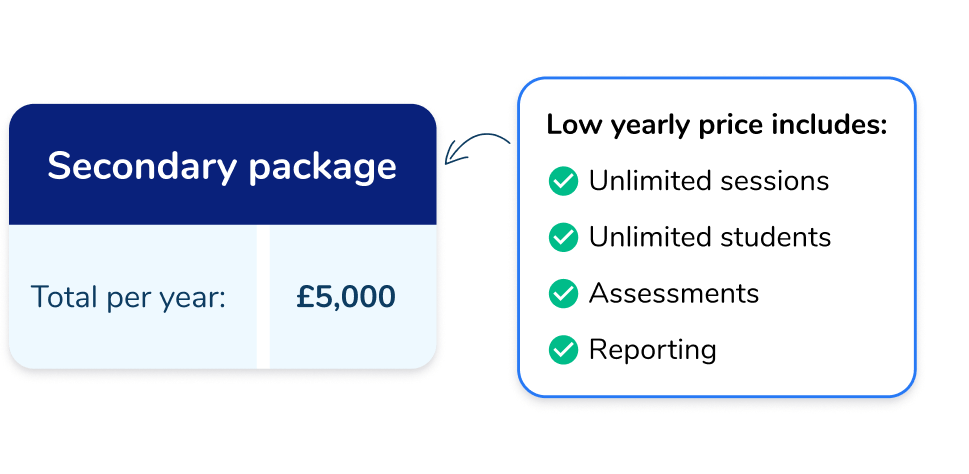
Low-cost one-to-one support for every secondary student who needs it
With Skye, you can run as many one-to-one maths sessions as needed across Year 7 and GCSE, all for one fixed yearly cost of £5,000.
If more students need support during the year, there’s no need to find additional budget or limit places. Simply add sessions and students as required.
The average secondary school saves around 90% compared to traditional one-to-one tutoring providers..
Structured, scaffolded secondary maths lessons
Every teacher-designed lesson, whether supporting Year 7 transition or preparing students for GCSE, follows an “I do, we do, you do” approach.
Trained on every lesson in the curriculum, Skye adapts teaching to individual learning needs, addressing misconceptions, building confidence and securing the knowledge required for success at KS3 and GCSE.
Each session:
Starts with a short diagnostic assessment
Skips straight to independent practice if the pupil is ready
Moves into guided practice where needed
Provides targeted support where misconceptions arise
Ends with a summative assessment
Year 7 tutoringGCSE tutoring
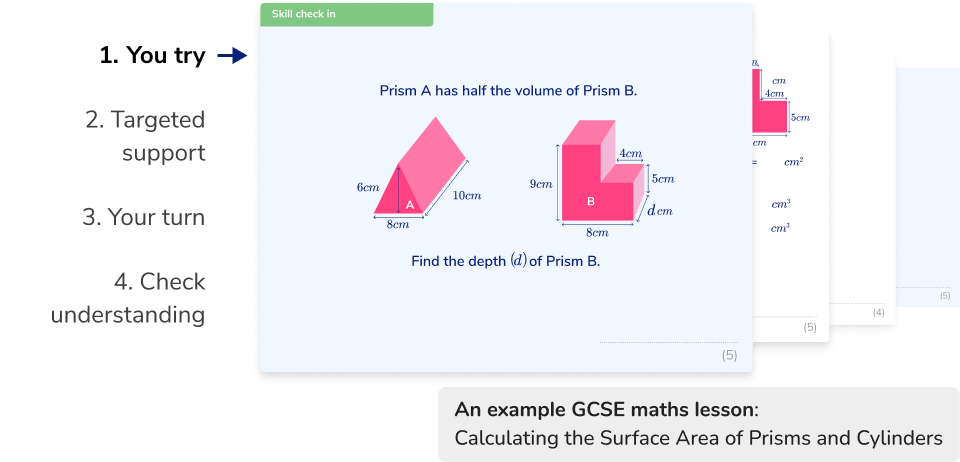
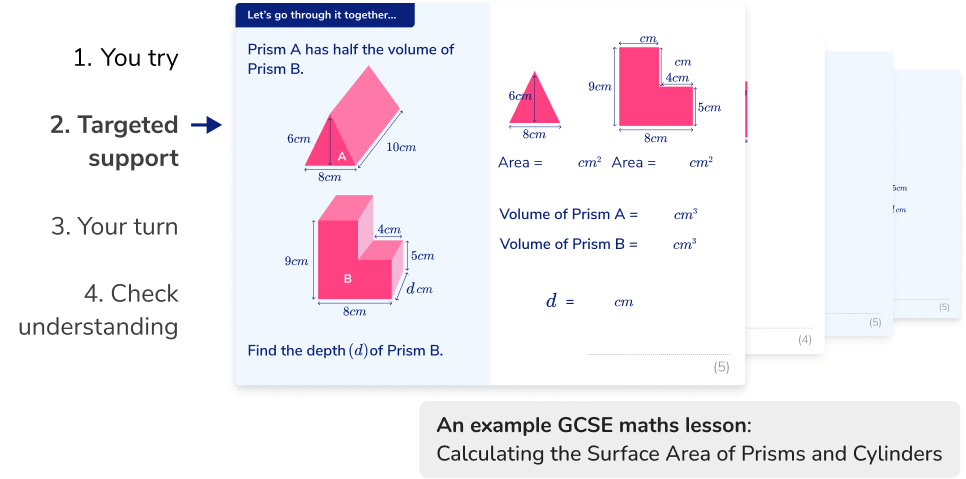
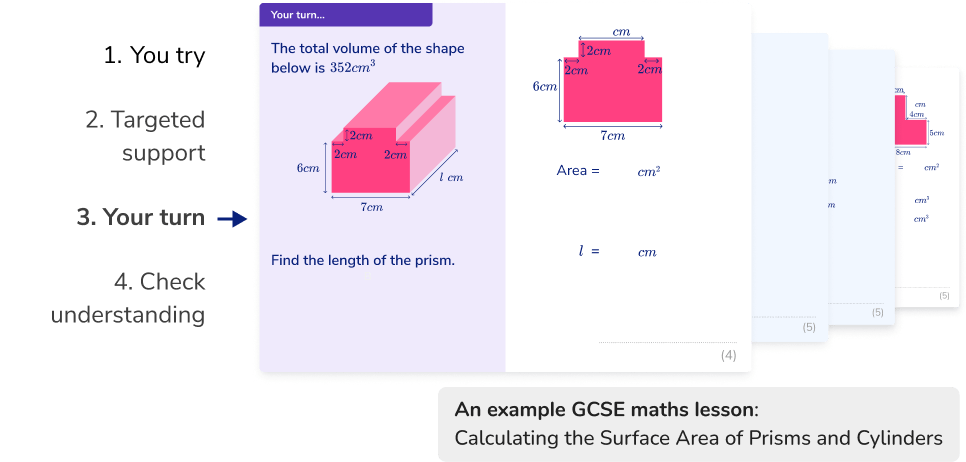
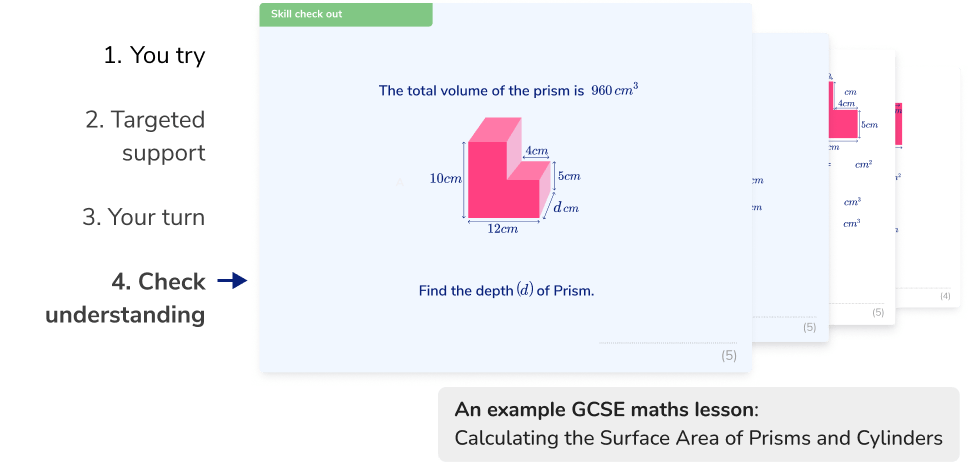
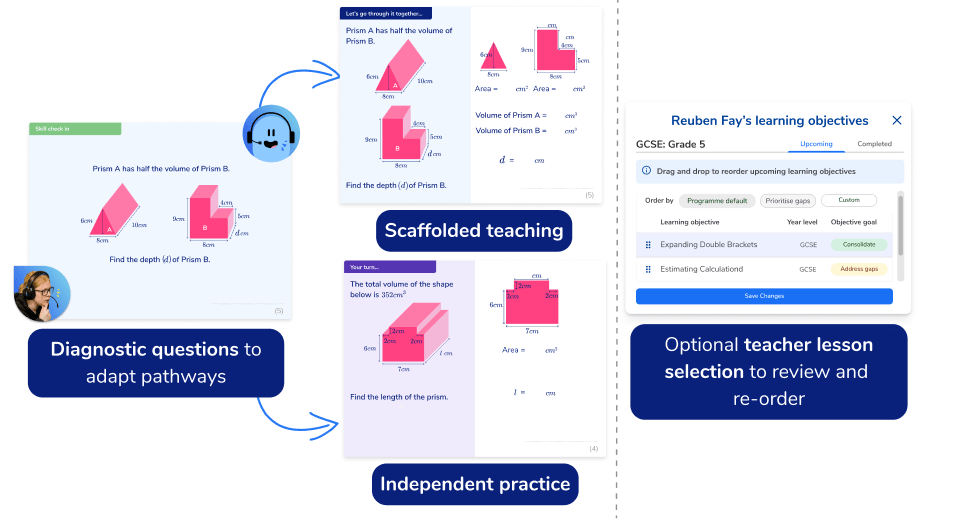
Personalised learning made easy at scale
Skye uses diagnostic questions to adapt maths teaching in real time, scaffolding support where needed or moving students to independent practice when they’re ready.
Teachers can easily re-order lessons at any point to align with their Year 7 priorities or GCSE intervention and revision goals.
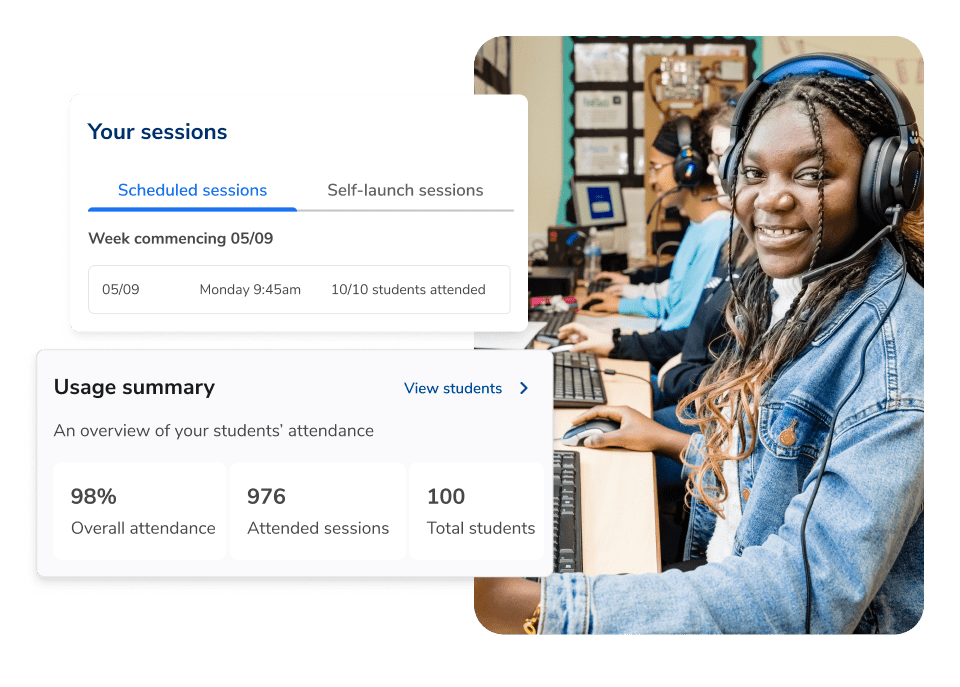
Flexible secondary maths tutoring wherever you need it
Unlike traditional tutoring, Skye is low-cost, fully flexible and always available, meaning you can use one-to-one support far beyond a fixed intervention slot.
Extra maths practice with ad-hoc, on-demand sessions
Intensive GCSE maths revision in the run-up to exams
Targeted Year 7 transition support
Cover to address staff absences or subject specialist shortages
Homework and independent study support
As a virtual Teaching Assistant
Keeping learners safe with Skye
Safeguarding is built in by design
Structured content: Skye can only access maths lessons created and controlled by our academic team. Guardrails ensure interactions stay on track and age-appropriate.
Session recordings: All secondary tutoring sessions are recorded and transcribed, with access available to schools for full transparency.
Red flag policy: Safeguarding concerns are automatically flagged for review and escalation.
Trusted processes: Safeguarding policies previously approved by the Department for Education under the National Tutoring Programme
Structured content: Skye can only access maths lessons created and controlled by our academic team. Guardrails ensure interactions stay on track and age-appropriate.
Session recordings: All secondary tutoring sessions are recorded and transcribed, with access available to schools for full transparency.
Red flag policy: Safeguarding concerns are automatically flagged for review and escalation.
Trusted processes: Safeguarding policies previously approved by the Department for Education under the National Tutoring Programme
Book a free maths tutoring taster for your school
Get in touch today to arrange a free secondary taster session with AI maths tutor Skye. On a quick call, we’ll set everything up so you can see how unlimited maths tutoring can support your secondary school:
Trusted by more than 4,100 schools since 2013
Unlimited one-to-one tutoring for one low fixed cost
Developed by qualified secondary maths teachers for maximum academic impact
Built using insights from 2.1 million one to one tutoring sessions in schools
Designed to help students achieve their target GCSE maths grade
You can learn more about how we keep your data safe and secure in our privacy policy.
Want to discuss your pupils’ needs and see how Third Space
Learning can support your school?
Book a demo here.