High Impact Tutoring Built By Math Experts
Personalized standards-aligned one-on-one math tutoring for schools and districts
In order to access this I need to be confident with:
Addition and subtraction Skip counting Multiplication and divisionPrime and composite numbers
Here you will learn about prime and composite numbers, including what prime and composite numbers are and how to determine whether a number is prime or composite.
Students will first learn about prime and composite numbers as a part of operations and algebraic thinking in 4 th grade.
What are prime and composite numbers?
Prime numbers are natural numbers (whole numbers) that are greater than 1 and cannot be divided by any other whole number other than itself and 1.
The number 1 is not a prime number since it only has one factor, 1.
For example, the number 7 is prime because it has 2 divisors, 1 and itself, 7.
Composite numbers are positive integers that have more than two factors.
For example, the number 12 is composite because it has 6 divisors, 1, 2, 3, 4, 6, and 12.
There are two types of composite numbers, even composite numbers and odd composite numbers. To determine whether a number is composite, you can use the following properties of composite numbers:
- A composite number has more than two factors.
- The smallest composite number is 4.
- All even numbers are composite, except for the number 2.
- The number has at least two prime factors.
Identifying prime and composite numbers
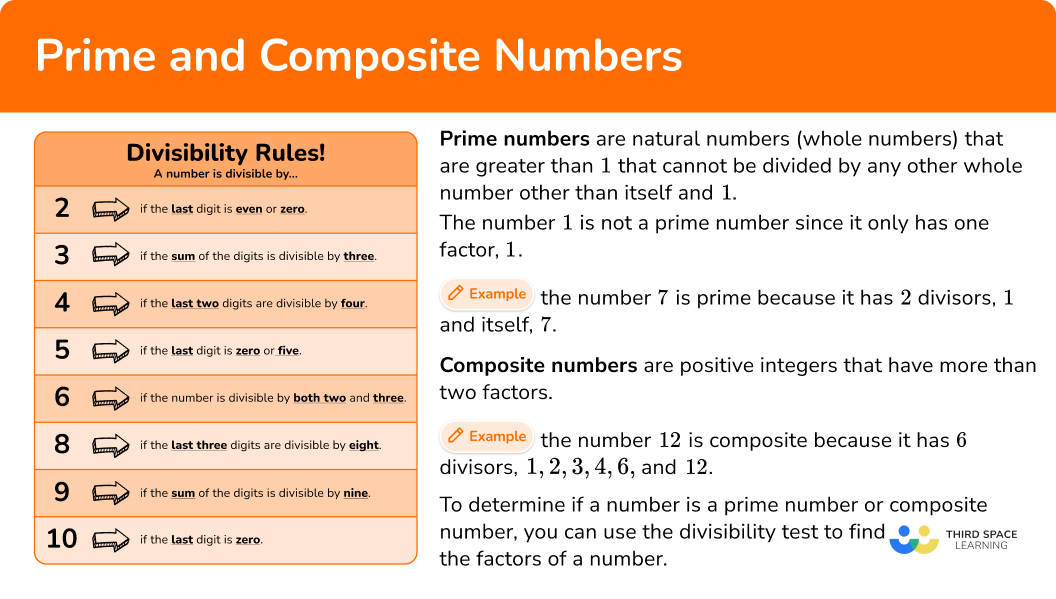
To determine if a number is a prime number or composite number, you can use the divisibility test to find the factors of a number. If the given number has only 2 factors (1 and itself ) the number is prime. If the given number has more than 2 factors, it’s composite.
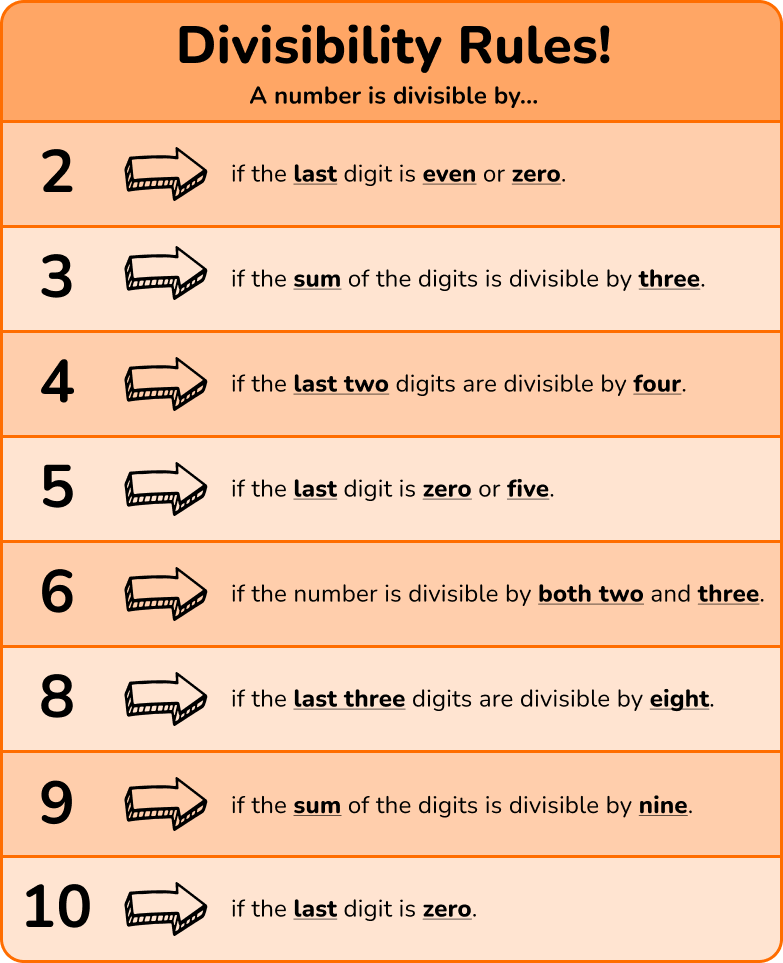
To perform a divisibility test, you can use the following divisibility rules:
What are prime and composite numbers?
Common Core State Standards
How does this relate to 4 th grade math?
- Grade 4: Operations and Algebraic Thinking (4.OA.B.4)
Find all factor pairs for a whole number in the range 1–100. Recognize that a whole number is a multiple of each of its factors. Determine whether a given whole number in the range 1–100 is a multiple of a given one-digit number. Determine whether a given whole number in the range 1–100 is prime or composite.
![[FREE] Types of Number Check for Understanding Quiz (Grade 2, 4 and 6)](https://thirdspacelearning.com/wp-content/uploads/2023/06/Types-of-number-check-for-understanding-listing-image.jpg)
[FREE] Types of Number Check for Understanding Quiz (Grade 2, 4 and 6)
Use this quiz to check your grade 6 students’ understanding of types of numbers. 10+ questions with answers covering a range of 2nd, 4th and 6th grade types of numbers topics to identify areas of strength and support!
DOWNLOAD FREE [FREE] Types of Number Check for Understanding Quiz (Grade 2, 4 and 6)
Use this quiz to check your grade 6 students’ understanding of types of numbers. 10+ questions with answers covering a range of 2nd, 4th and 6th grade types of numbers topics to identify areas of strength and support!
DOWNLOAD FREEHow to identify prime and composite numbers
In order to determine whether a number is a prime number or composite number:
- Use the divisibility rules to see whether \bf{2, 3} or \bf{5} is a factor.
- If they are not factors, test for divisibility by \bf{7} and \bf{8}.
- State whether the number is prime or composite.
Prime and composite numbers examples
Example 1: determine if a given number is prime or composite
Is 17 prime or composite?
- Use the divisibility rules to see whether \bf{2, 3} or \bf{5} is a factor.
The last digit is not a 2, 4, 6, 8, or 0 so it is not a multiple of 2.
Adding the digits together, we have 1+7=8, so it is not a multiple of 3.
The last digit is not a 5 or a 0, and so it is not a multiple of 5.
2If they are not factors, test for divisibility by \bf{7} and \bf{8}.
Start by dividing by 7\text{:}
As 17 \div 7=2 \; r 3, \, 7 is not a factor of 17.
Next divide by 8\text{:}
As 17 \div 8=2 \; r 1, \, 8 is not a factor of 17.
The number 17 is not divisible by 7 or 8, so there are no more whole numbers that you need to try.
3State whether the number is prime or composite.
17 is a prime number as it only has two factors, 1 and 17.
Example 2: determine if a given number is prime or composite
Is 63 prime or composite?
The last digit is not a 2, 4, 6, 8, or 0, so it is not a multiple of 2.
Adding the digits together you have 6+3=9 , so it is a multiple of 3.
The number 63 is divisible by 3, so there are no more whole numbers that we need to try.
The number 63 is divisible by 3, so there are no more whole numbers that you need to try.
63 is a composite number.
Example 3: determine if the given numbers are prime numbers or composite numbers.

The last digit of 16 is a 6, so 16 is a multiple of 2.
If you add the digits of 27 together, you get 2+7=9, which is a multiple of 3. 27 is a multiple of 3.
The number 5 has a 5 as a factor, but it’s the only factor other than 1. 5 is prime.
The last digit of 92 is 2, so 92 is also a multiple of 2.
Divide 77 by 7 and 8 until you reach the first number that gives a quotient that is a whole number.
Start by dividing by 7\text{:}
77 \div 7=11, which is a factor of 7.
The numbers 16, 27, 77 and 92 are composite and the number 5 is prime.
Example 4: determine if the given numbers are prime numbers or composite numbers.

The last digit of 24 and 54 are even, so both numbers have a factor of 2.
The number 5 ends in a 0 or 5, so it has a factor of 5.
Divide 17 and 89 by 7 and 8, using long division, until you reach the first number that gives a quotient that is a whole number.
Start by dividing 17 by 7\text{:}
As 17 \div 7=2 \; r 3, \, 7 is not a factor of 17.
Next, divide 17 by 8\text{:}
As 17 \div 8=2 \; r 1, \, 7 is not a factor of 17.
Next, divide 89 by 7\text{:}
As 89 \div 7=12 \; r 5, \, 7 is not a factor of 89.
Next, divide 89 by 8\text{:}
As 89 \div 8=11 \; r 1, \, 8 is not a factor of 89.
The numbers 17 and 89 are not divisible by 7 or 8, so there are no more whole numbers that need to be tried.
The numbers 24, 35 and 54 are composite, and the numbers 17 and 89 are prime.
Example 5: list the composite numbers between 90 and 99 .
Determine which of the following numbers are composite:
91, 92, 93, 94, 95, 96, 97, and 98.
92, 94, 96 and 98 end with even numbers, meaning that 2 is a factor.
93 has 3 as a factor because when you add the digits, 9+3=12, 12 is divisible by 3.
95 ends in a 5 or 0, so 5 is a factor of 95.
Divide 91 and 97 by 7 and 8, using long division, until you reach the first number that gives a quotient that is a whole number.
Start by dividing 91 by 7\text{:}
As 91 \div 7=13, \, 7 is a factor of 97.
Next, divide 97 by 7\text{:}
As 97 \div 7=13 \; r 6, \, 7 is not a factor of 97.
Next, divide 97 by 8\text{:}
As 97 \div 8=12 \; r 1, \, 8 is not a factor of 97.
The number 97 is not divisible by 7 or 8, so there are no more whole numbers that need to be tried.
The composite numbers between 90 and 99 are: 91, 92, 93, 94, 95, 96 and 98.
Example 6: list the prime numbers between 60 and 70.
Determine which of the following numbers are prime:
61, 62, 63, 64, 65, 66, 67, 68, 69.
62, 64, 66 and 68 end with even numbers, meaning that 2 is a factor.
63 has 3 as a factor because when you add the digits, 6+3=9, 9 is divisible by 3.
65 ends in a 5 or 0, so 5 is a factor of 65.
69 has 3 as a factor because when you add the digits, 6+9=15, 15 is divisible by 3.
Divide 61 and 67 by 7 and 8, using long division, until you reach the first number that gives a quotient that is a whole number.
Start by dividing 61 by 7\text{:}
As 61 \div 7=8 \; r 5, \, 7 is not a factor of 61.
Next, divide 61 by 8\text{:}
As 61 \div 8=7 \; r 5, \, 8 is not a factor of 61.
Next, divide 67 by 7\text{:}
As 67 \div 7=9 \; r 4, \, 7 is not a factor of 67.
Next, divide 67 by 8\text{:}
As 67 \div 8=8 \; r 3, \, 8 is not a factor of 67.
The numbers 61 and 67 are not divisible by 7 or 8, so there are no more whole numbers that need to be tried.
The prime numbers between 60 and 70 are 61 and 67.
Teaching tips for prime and composite numbers
- Have students in your math classes find examples of composite numbers using divisibility rules to compile in a class list. This list can be printed and given as a list of composite numbers and a list of prime numbers to refer back to when needed.
- Instead of using worksheets where students have to identify whether a number is prime or composite, use manipulative and hands-on activities for students to sort numbers.
Easy mistakes to make
- \bf{1} is not a prime or composite number
1 is not a prime or composite number. This is because it only has one factor, rather than the 2 or more factors needed to be prime or composite.
- All even numbers are composite
2 is the only even prime number, because it only has two factors, 1 and itself. Every other even number is divisible by 2. \, 2 is a special case when discussing prime numbers.
- All prime numbers are odd
All but one of the prime numbers are odd, it can be assumed that all odd numbers are prime. However, not all odd numbers are prime, and not all prime numbers are odd. For example, the number 15 is an odd number. The number 15 is a multiple of 3 and 5 and is composite.
Related types of numbers lessons
Practice prime and composite numbers questions
1) Is 49 prime or composite?
Neither

Not enough information is given
Prime
Composite

Use divisibility rules to determine whether 49 is prime or composite.
49 is not a multiple of 2, 3 or 5, so test divisibility for 7 or 8.
49 \div 7=7, so 7 is a factor of 49.
49 is composite.
2) Is 73 prime or composite?
Prime
Composite
Neither
Not enough information is given
Use divisibility rules to determine whether 73 is prime or composite.
73 is not a multiple of 2, 3 or 5, so test divisibility for 7 or 8.
73 \div 7=10 \; r3, so 7 is not a factor of 73.
73 \div 8=9 \; r1, so 8 is not a factor of 73.
73 is prime.
3) Which of the following numbers is prime?

Use divisibility rules to determine which number is prime. Prime numbers will only have 2 factors, 1 and itself.
54 and 82 are not prime because the last digits of the numbers are even, meaning 2 is a factor.
87 is not prime because when you add the digits, 8+7=15, \, 15 is divisible by 3, making 3 a factor of 87.
97 is prime.
4) Which of the following numbers is composite?

Use divisibility rules to determine which number is composite. Composite numbers have more than 2 factors.
33 is not prime, because when you add the digits, 3+3=6, 6 is divisible by 3, making 3 a factor of 33.
23, 59, and 83 only have 2 factors, 1 and itself.
33 is composite.
5) Which of the following answer choices lists all composite numbers between 20 and 30?
Determine which of the following numbers are composite:
21, 22, 23, 24, 25, 26, 27, 28, 29.
22, 24, 26 and 28 end with even numbers, meaning that 2 is a factor.
21 has 3 as a factor because when you add the digits, 2+1=3, \, 3 is divisible by 3.
25 ends in a 5 or 0, so 5 is a factor of 25.
27 has 3 as a factor because when you add the digits, 2+7=9, \, 9 is divisible by 3.
Divide 23 and 29 by 7 and 8, using long division, until you reach the first number that gives a quotient that is a whole number.
The numbers 23 and 29 are not divisible by 7 or 8, so there are no more whole numbers that need to be tried.
The numbers 21, 22, 24, 25, 26, 27, 28 are composite numbers.
6) Which of the following answer choices lists all prime numbers between 70 and 80?
73 and 79
72, 74, and 78
71, 73 and 79
Determine which of the following numbers are composite:
71, 72, 73, 74, 75, 76, 77, 78, 79.
72, 74, 76 and 78 end with even numbers, meaning that 2 is a factor.
75 ends in a 5 or 0, so 5 is a factor of 75.
77 has 7 as a factor because 7 \times 11=77.
Divide 71, 73 and 79 by 7 and 8, using long division, until you reach the first number that gives a quotient that is a whole number.
The numbers 71, 73 and 79 are not divisible by 7 or 8, so there are no more whole numbers that need to be tried.
The numbers 71, 73 and 79 are prime numbers.
Prime and composite numbers FAQs
A primality test is a mathematical algorithm or procedure designed to determine whether a given number is a prime number or not. The goal of such a test is to identify prime numbers without having to factorize the number completely.
A highly composite number is a positive integer that has more divisors than any positive integer smaller than itself. Examples of highly composite numbers include 2, 4, 6, 12, 24, 48, 60, 120 and 180.
The next lessons are
Still stuck?
At Third Space Learning, we specialize in helping teachers and school leaders to provide personalized math support for more of their students through high-quality, online one-on-one math tutoring delivered by subject experts.
Each week, our tutors support thousands of students who are at risk of not meeting their grade-level expectations, and help accelerate their progress and boost their confidence.

Find out how we can help your students achieve success with our math tutoring programs.
[FREE] Common Core Practice Tests (3rd to 8th Grade)
Prepare for math tests in your state with these 3rd Grade to 8th Grade practice assessments for Common Core and state equivalents.
Get your 6 multiple choice practice tests with detailed answers to support test prep, created by US math teachers for US math teachers!