High Impact Tutoring Built By Math Experts
Personalized standards-aligned one-on-one math tutoring for schools and districts
In order to access this I need to be confident with:
2D shapes Coordinate planeLine graph
Parallel lines Perpendicular linesRotational symmetry
Here you will learn about rotational symmetry, including rotational symmetry within polygons, angle properties, and symmetry of different line graphs.
Students will first learn about rotational symmetry as part of geometry in high school.
What is rotational symmetry?
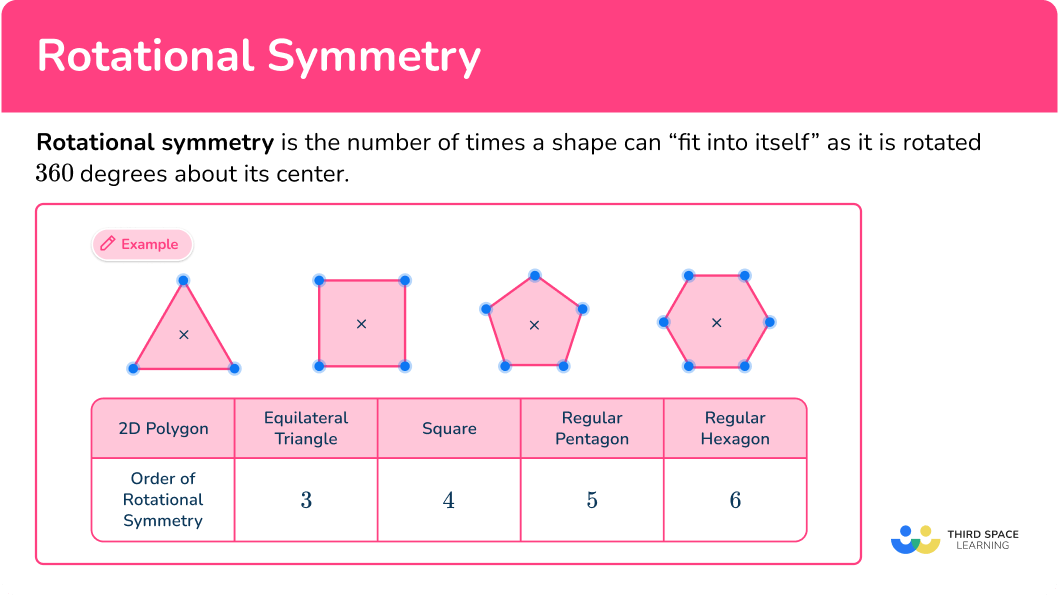
Rotational symmetry is the number of times a shape can “fit into itself” as it is rotated 360 degrees about its center. Rotational symmetry is also known as radial symmetry.
For example,
A rectangle has a rotational symmetry of order 2 shown below where one vertex is highlighted with a circle and the center of the shape is indicated with an ‘x’. In the diagram, the shape looks identical in two orientations and so the rotational symmetry of the rectangle is 2.

To calculate the order of rotational symmetry of a shape, you need to locate the center of the shape.
If the polygon has an even number of sides, this can be done by joining the diagonals. If the polygon has an odd number of sides, this can be done by joining each vertex to the midpoint of the opposing side.
You then rotate the shape 360 degrees around the center and see how many times the shape looks exactly like the original.
Rotational symmetry in regular shapes
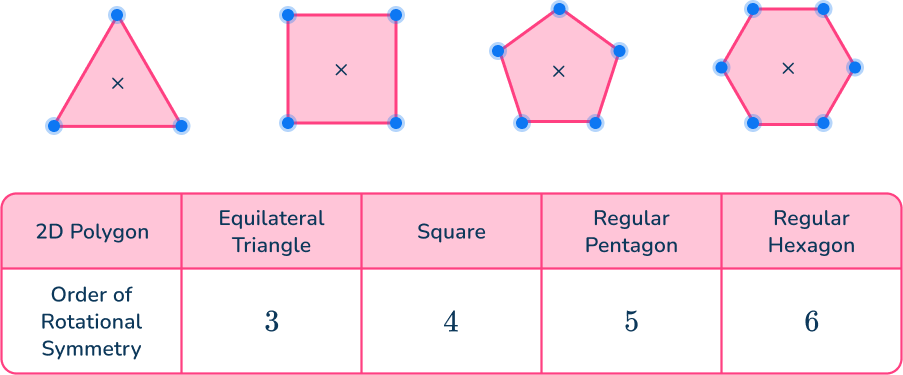
Many 2D shapes have a rotational symmetry. Regular polygons have the same number of sides as their rotational symmetry due to the angles and side lengths within the shape being the same.
![[FREE] Symmetry Worksheet (Grade 4 to 5)](https://thirdspacelearning.com/wp-content/uploads/2024/05/Symmetry-Worksheet-listing-image.png)
[FREE] Symmetry Worksheet (Grade 4 to 5)
Use this worksheet to check your grade 4 to 5 students’ understanding of symmetry. 15 questions with answers to identify areas of strength and support!
DOWNLOAD FREE [FREE] Symmetry Worksheet (Grade 4 to 5)
Use this worksheet to check your grade 4 to 5 students’ understanding of symmetry. 15 questions with answers to identify areas of strength and support!
DOWNLOAD FREERotational symmetry in irregular shapes
If a shape is rotated around its center and the shape returns to the original position without it “fitting into itself”, then the shape is described to have no rotational symmetry. Irregular shapes tend to have no rotational symmetry.
As soon as the angles in two-dimensional shapes change from their equal property, the order of rotational symmetry changes.
Let’s look at different shapes (specifically quadrilaterals) and their order of rotational symmetry.
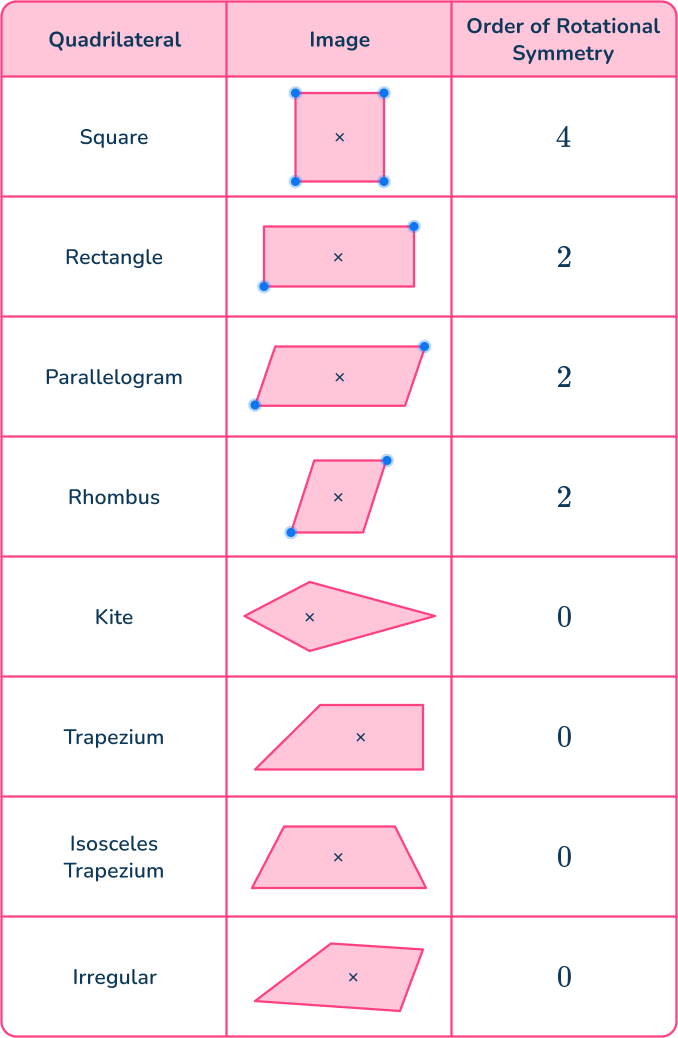
The kite is interesting because it may appear to have rotational symmetry since it has a line of symmetry. However, if the shape is rotated around its center, it returns back to the original orientation without it fitting into itself again so the order of rotational symmetry for a kite is 0.
This is also true for any quadrilateral that is not a square, rectangle, parallelogram, or rhombus.
Rotational symmetry in graphs
You can also consider rotational symmetry with different types of graphs.
For example,
Below is the graph of the equation y=x.
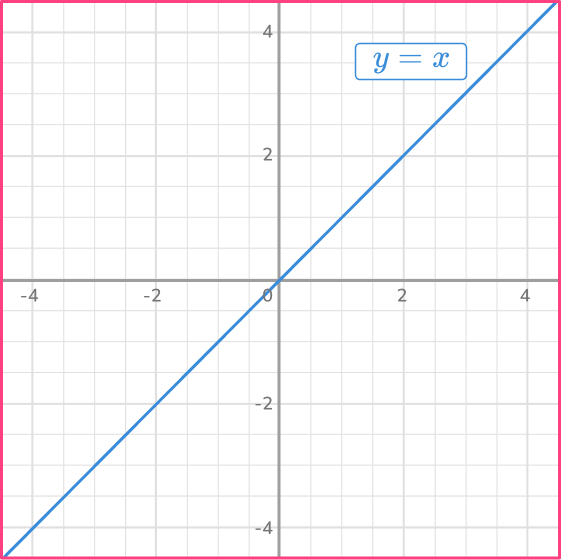
Given that the line extends in both directions beyond the axes drawn above, you can use the origin as a center of rotation. If you rotate the line 180 degrees about the origin, you will get exactly the same line. Continuing this rotation all the way through 360^{\circ}, you get back to the original.
So the line y=x has an order of rotation of 2.
Rotational symmetry in circles
A regular hexagon has an order of rotation of 6, an octagon has an order of rotation of 8, and a dodecagon has an order of rotation of 12. But what about a circle?
A circle can be rotated around its center and the shape will remain identical as the radius is the same for every point on the circumference of the circle.
This means that the order of rotational symmetry for a circle is infinite.
What is rotational symmetry?
Common Core State Standards
How does this relate to high school math?
- High school: Geometry – Congruence (HS.G.CO.A.3)
Given a rectangle, parallelogram, trapezoid, or regular polygon, describe the rotations and reflections that carry it onto itself.
How to calculate the order of rotational symmetry
In order to calculate the order of rotational symmetry:
- Locate the center of the 2D shape.
- Trace the shape onto a piece of tracing paper including the center and northline.
- Rotate the tracing around the center and count the number of identical occurrences.
Rotational symmetry examples
Example 1: the isosceles triangle
Calculate the order of rotation for the isosceles triangle below.

- Locate the center of the 2D shape.
Draw a small x in the center of the triangle (draw a line from each vertex to the midpoint of the line opposite).
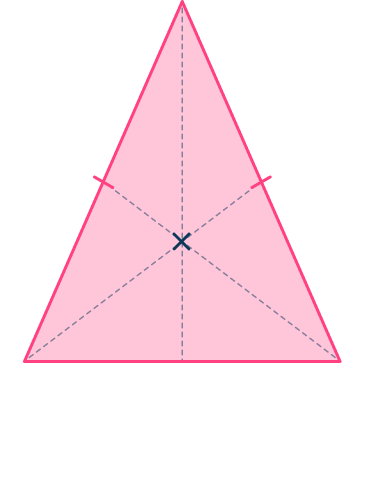
2Trace the shape onto a piece of tracing paper including the center and northline.
Here you use tracing paper to trace the shape, including the center of the shape and an upward arrow (northline). The northline shows us when the shape is facing the original orientation.
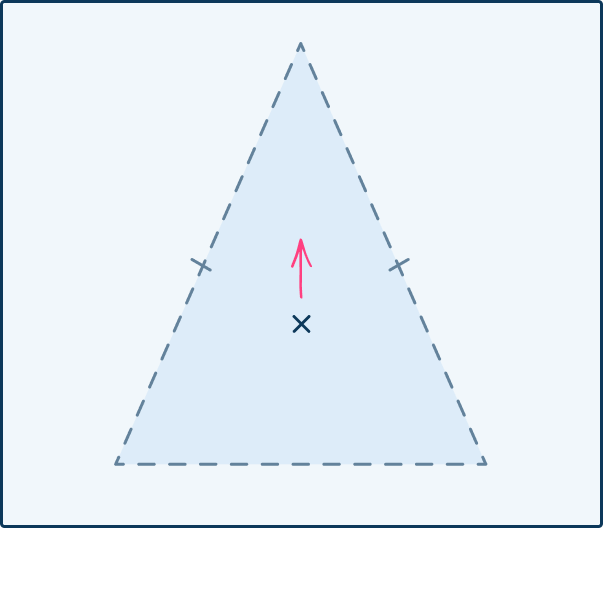
3Rotate the tracing around the center and count the number of identical occurrences.
Rotating the shape around the center, you have to turn the shape all 360^{\circ} before the traced image looks identical to the original.
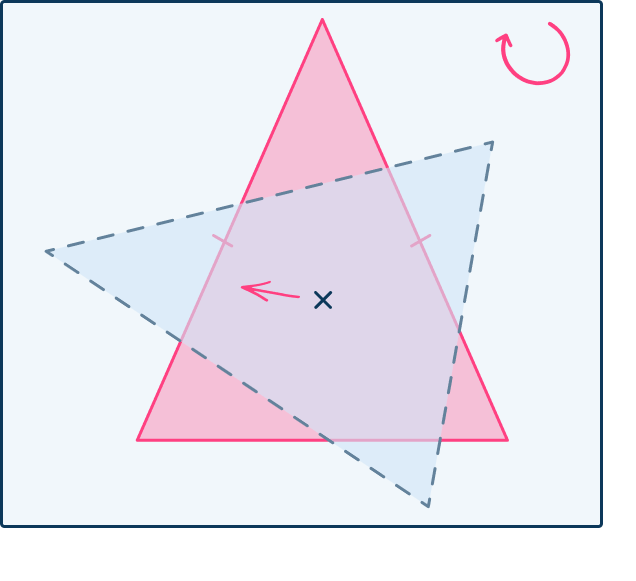
The isosceles triangle has a rotational symmetry of order 0.
Example 2: the regular hexagon
Calculate the order of rotational symmetry for a regular hexagon.

Draw a small x in the center of the hexagon (join the opposing vertices together to locate the center).
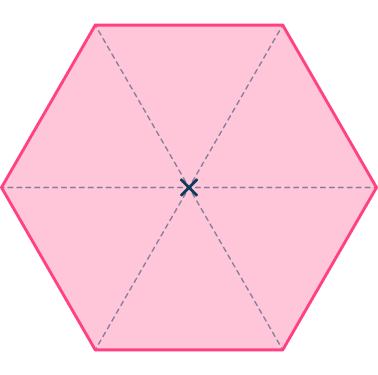
As the regular hexagon has a lot of vertices, it is useful to also draw a dot in one vertex so you don’t lose sight of what the original looks like.
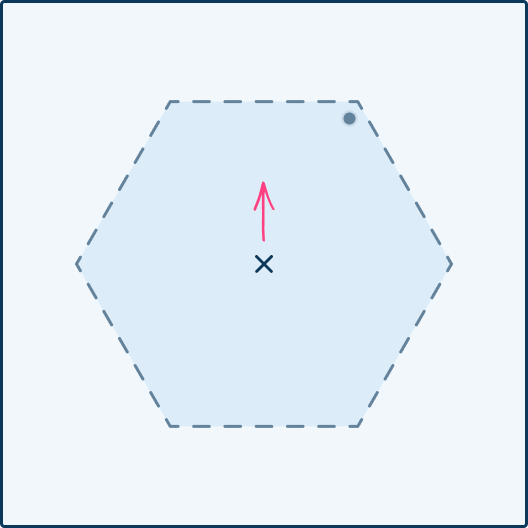
Rotating the shape around the center, there are multiple occasions when the shape is identical to the original. Below are multiple stages of the rotation:
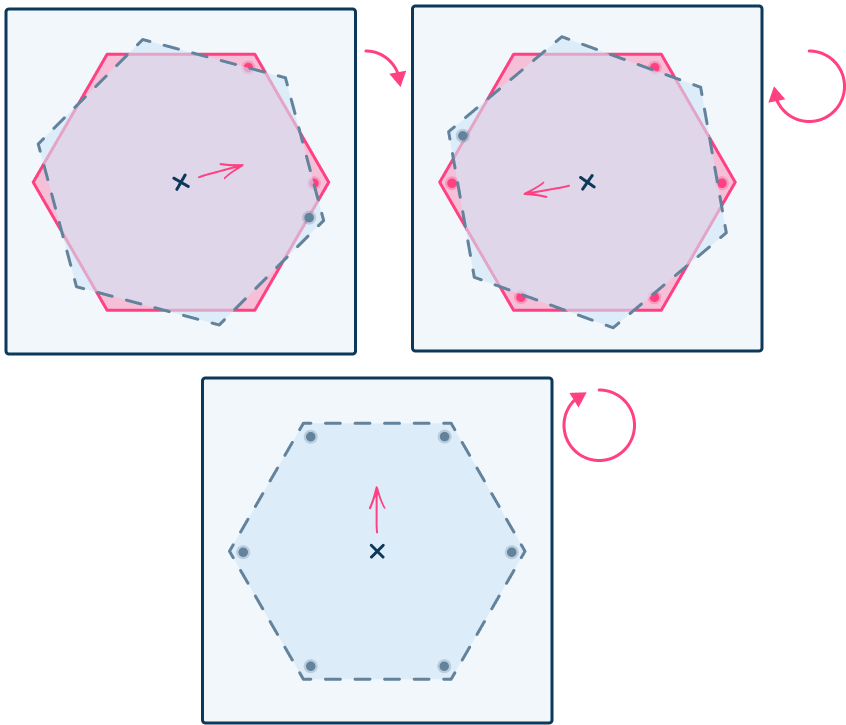
By placing a dot in each position when the shape is identical, you can count the order of rotation once the shape has been rotated 360^{\circ} around the center.
The regular hexagon has a rotational symmetry of order 6.
Tip: a shape cannot have a rotational symmetry of 1 but you include the original orientation if the shape has a rotational symmetry.
Example 3: using angles
Calculate the rotational symmetry of the octagon below.
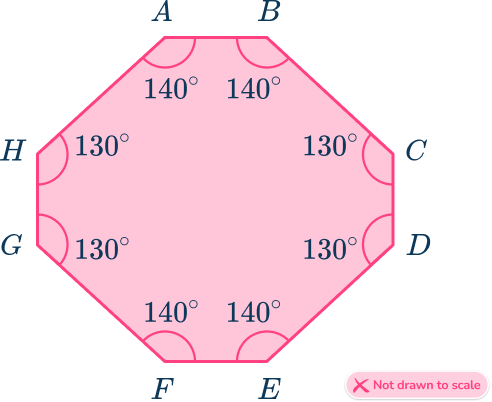
Draw a small x in the center of the hexagon (join the opposing vertices together to locate the center).
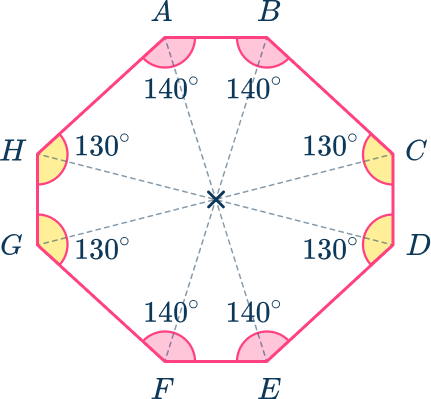
Being able to visualize the rotation without tracing is a difficult skill, however, for this example, as the shape is not drawn accurately, you cannot use the trace method. Instead, you need to think about the angles in the shape and whether or not the angles would match when you rotate the shape.
If you rotate the shape through 90 degrees, you can see that the angles in the octagon look like this:
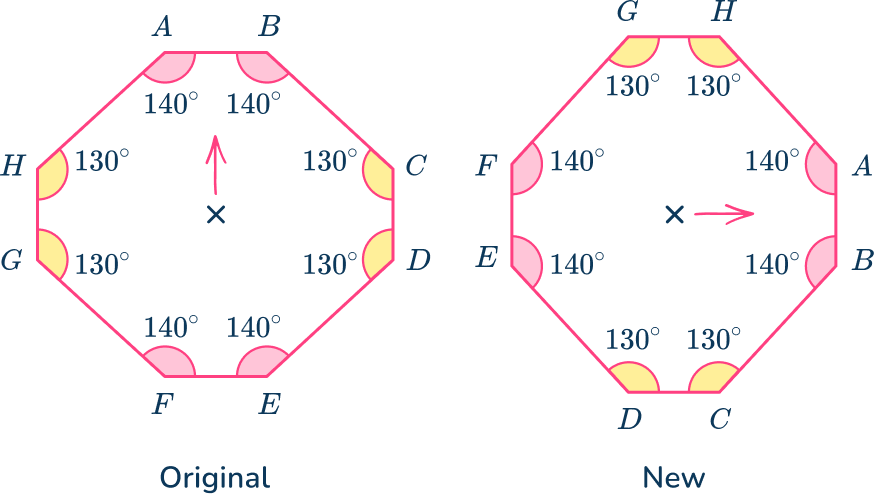
If you compare it to the original, you can see that the angles do not match, so let’s continue to rotate the shape clockwise:
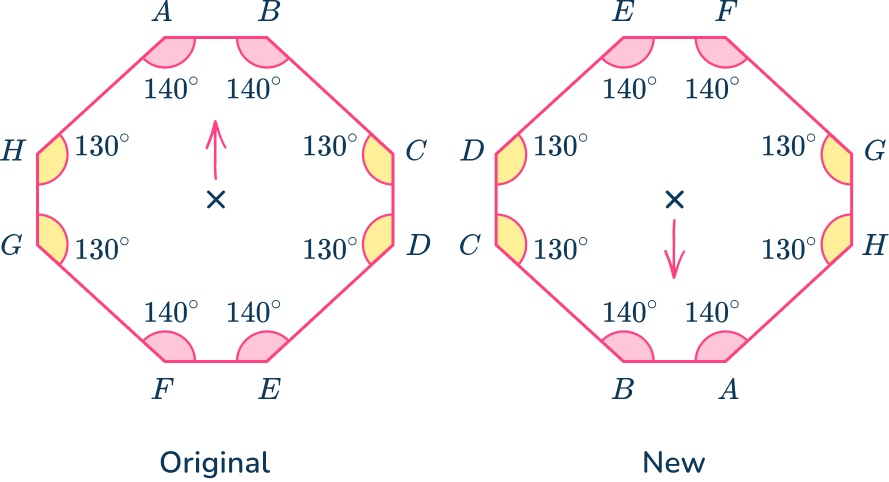
Now you have rotated the shape to 180^{\circ} from the original, you can see that the size of the angles match their original position.
If you rotated the shape a further 90 degrees, this would also not match the original and then you return the shape back to the original position.
This means that the order of rotational symmetry for this octagon is 2.
Tip: Divide the angle at the center by the number of sides in the shape. This angle can be used to rotate the shape around. For example, a hexagon can be rotated by an angle of 60^{\circ} clockwise six times to complete a full turn, a rectangle can be rotated 90^{\circ} clockwise four times to complete a full turn.
Example 4: angle facts
The shape ABCD has two pairs of parallel sides. Use angle facts to calculate the order of rotation for the shape ABCD.
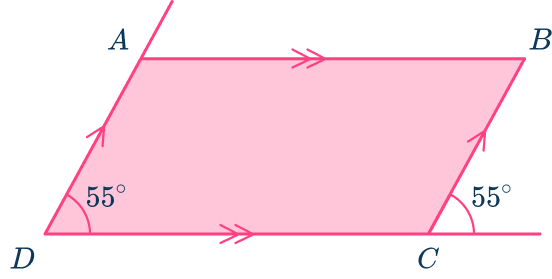
To find the center of the shape, join the diagonals together. Here you have:
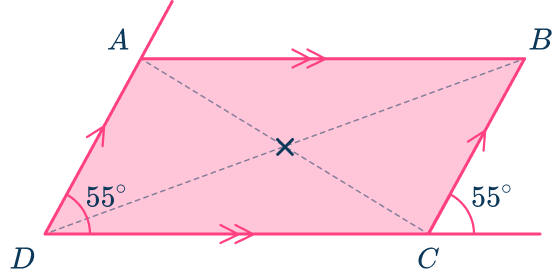
Next, you need to calculate all of the interior angles of the shape and use them to calculate the order of rotation:
BAD = 180 - 55 = 125^{\circ} (co-interior angles total 180^{\circ} )
BCD = 180 - 55 = 125^{\circ} (angles on a straight line total 180^{\circ} )
ABC = 180 - 125 = 55^{\circ} (co-interior angles total 180^{\circ} )
You now have the following information:
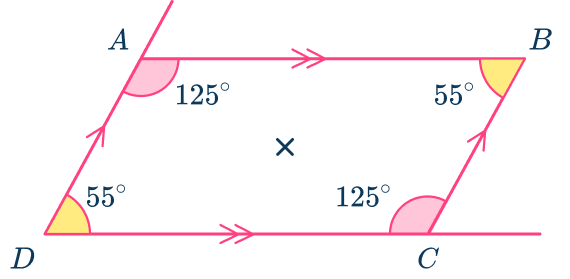
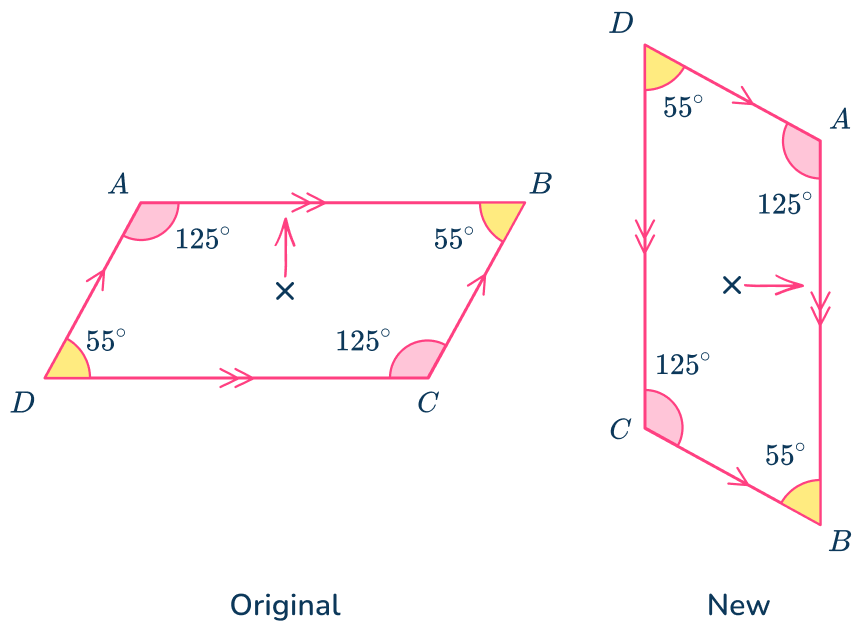
Again, you are going to try visualizing the rotation without tracing paper. As the shape is a quadrilateral, you will visualize turning the object through four 90 -degree turns in a clockwise direction and see if the angles match.
By rotating the shape 90^{\circ} clockwise, you get a shape that is not exactly like the original.
Continuing this by another 90 -degree rotation, you get
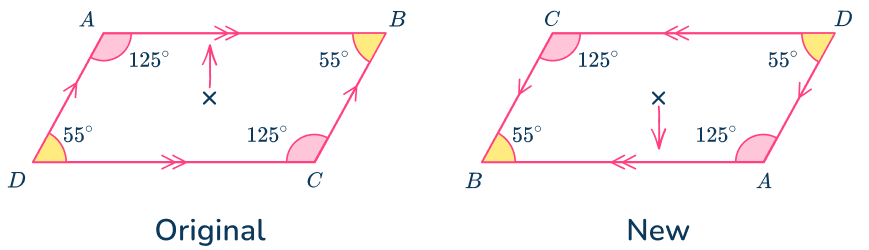
If you rotated the shape a further 90 degrees, this would also not match the original and then you return the shape back to the original position.
The order of rotational symmetry for the shape ABCD (which is a parallelogram) is 2.
Example 5: cubic graph
Calculate the order of rotational symmetry for the cubic graph y=x^3+2 around the center (0,2).
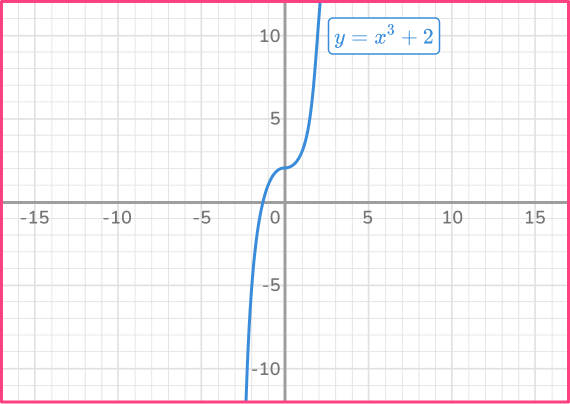
You know the center (0,2) so let us draw it onto the graph:
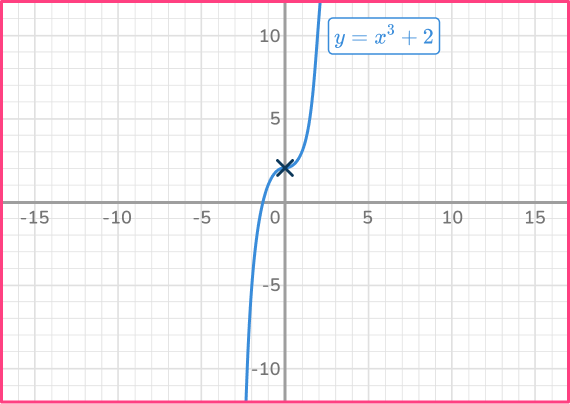
As the shape is now a graph, sketch the graph onto a piece of tracing paper. You do not need to include the axes as it is the graph that is important.
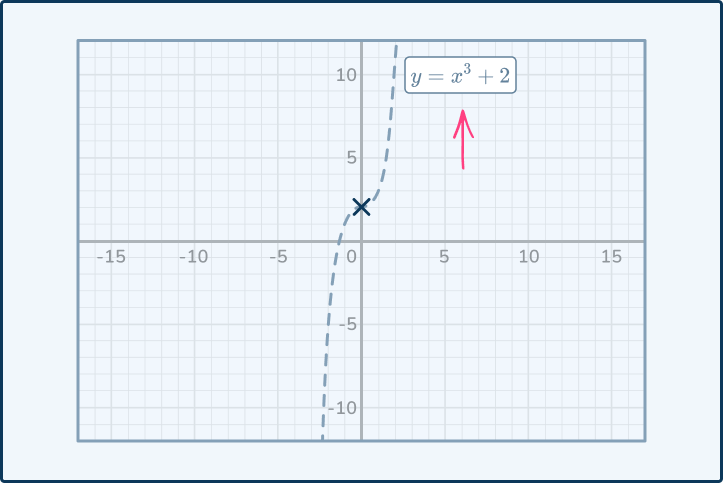
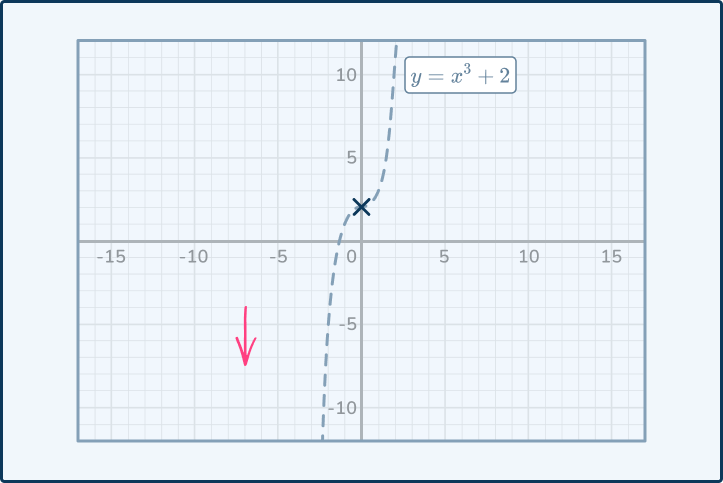
If you turn the tracing 180^{\circ} around the point (0,2) you get a match with the original. This is the only occurrence along with the original and so the order of rotation for the cubic graph y=x^3+2 around the point (0,2) is 2.
Example 6: sine graph
Calculate the order of rotational symmetry for the graph y=\sin (\theta) around the origin.
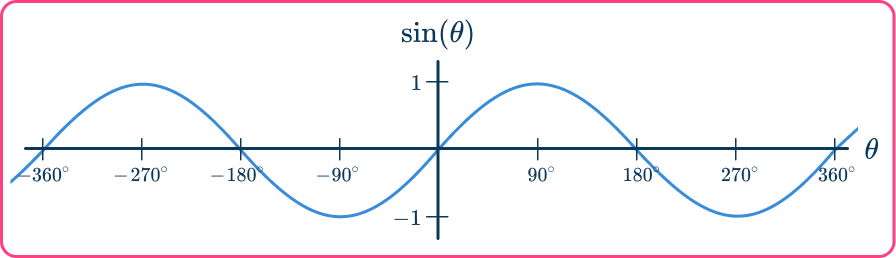
The center of rotation is given as the origin, so let us highlight this point on the graph:
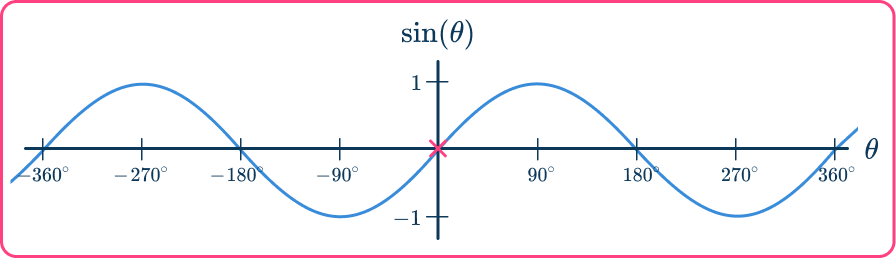
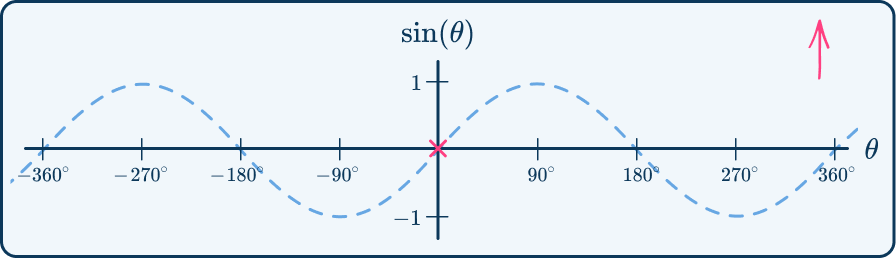
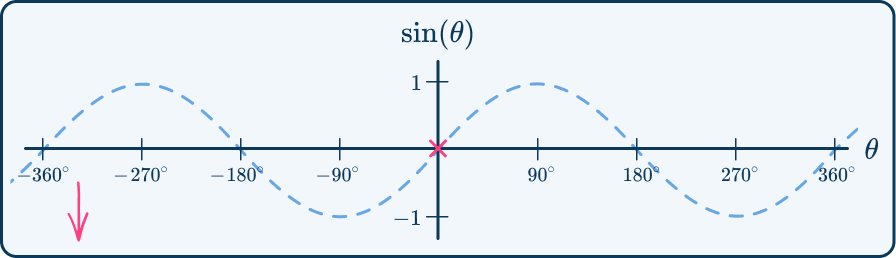
Here, you can only get an exact copy of the original image by rotating the tracing paper around the origin once excluding the original image.
The order of rotational symmetry for the graph of y=\sin (\theta) is 2.
Teaching tips for rotational symmetry
- Allow students to trace shapes on transparent paper or use plastic sheets, and rotate them to see how they fit over the original position.
- Use animations to visually demonstrate how shapes look the same after certain rotations.
- Provide cut-out shapes that students can physically rotate to observe rotational symmetry.
- Provide rotational symmetry worksheets with examples of shapes with various orders of rotational symmetry. Use shapes like squares, equilateral triangles, and regular hexagons.
Easy mistakes to make
- Confusing rotational symmetry with lines of symmetry
Lines of symmetry are mixed up with rotational symmetry. A line of symmetry divides the shape equally into two symmetrical pieces. A rotational symmetry is the number of times a shape fits into itself when rotated around its center.
- Thinking a shape can have an order of rotational symmetry of \bf{1}
A shape cannot have an order of rotational symmetry of 1. If a shape had a rotational symmetry of order 1, it would mean that it looks the same only after a full rotation of 360^{\circ}, which is true for all shapes.
The original shape is included if the shape has a rotational symmetry, so you must always have a rotational symmetry of at least 2. Saying a shape has rotational symmetry of order 1 is essentially saying it has no rotational symmetry at all.
- Thinking that the number of sides \bf{=} the order of rotational symmetry
Although this is true for regular shapes, this is not true for many rotationally symmetric shapes.
Related symmetry lessons
Practice rotational symmetry questions
1. Calculate the order of rotational symmetry for the kite below.




Labeling one corner and the center, if you rotate the polygon around the center, the kite rotates 360^{\circ} before it looks like the original so it has no rotational symmetry.
2. Calculate the rotational symmetry for this pentagon.

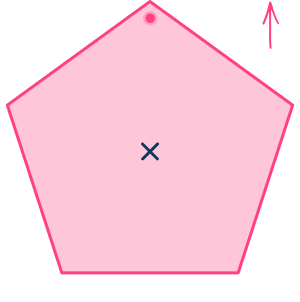
Labeling one corner and the center, if you rotate the polygon around the center, the pentagon rotates 360^{\circ} before it looks like the original so it has no rotational symmetry.
3. What is the order of rotational symmetry for the dodecagon below?


Labeling one corner and the center, if you rotate the polygon around the center, the polygon can rotate 90^{\circ} before it looks like the original. Placing a dot for each time the polygon fits (a further 3 rotations of 90^{\circ} ) so it has a rotational symmetry of 4.
4. Calculate the order of rotational symmetry for the following shape ABCDEF \text{:}
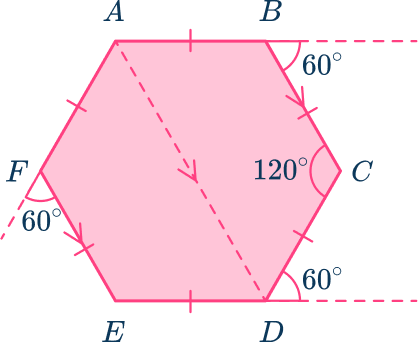
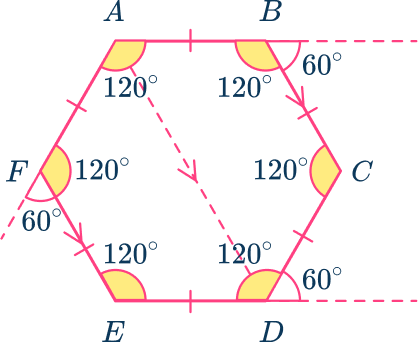
All the interior angles are equal to 120^{\circ} and all sides are equal length.
5. State the order of rotational symmetry for the graph y=4x-2 around the point (0,-2).
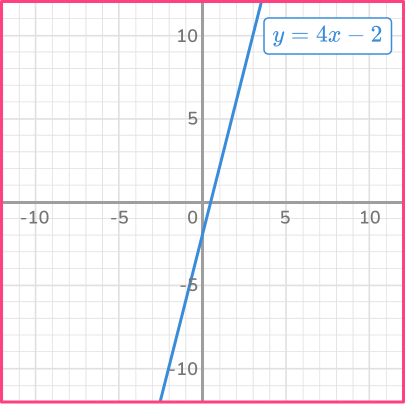
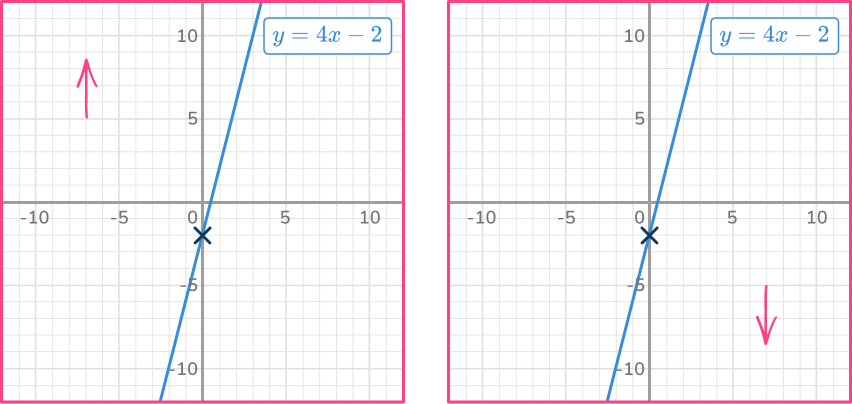
Rotating the graph 180^{\circ} around the point (0,- \, 2), you get an identical image of the original. A further rotation of 180^{\circ} returns the shape back to the original and so it has an order of rotation of 2.
6. Calculate the order of rotational symmetry for the graph of y=cos(x) around the center (0,0).
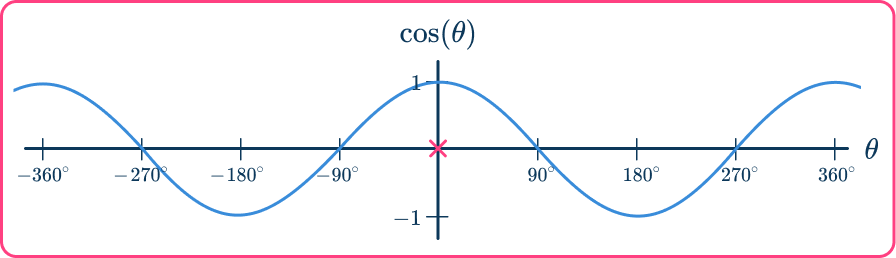
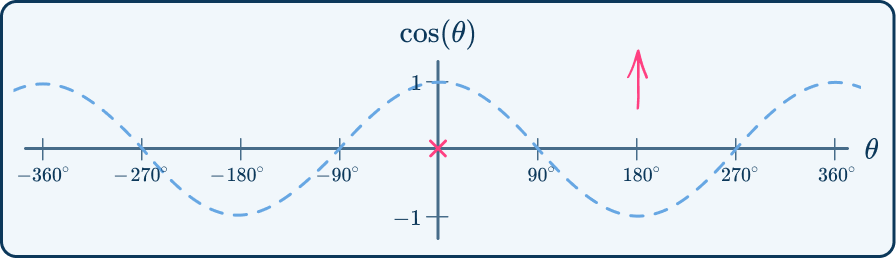
When rotated 180^{\circ}, this is the result. This is not identical to the original.
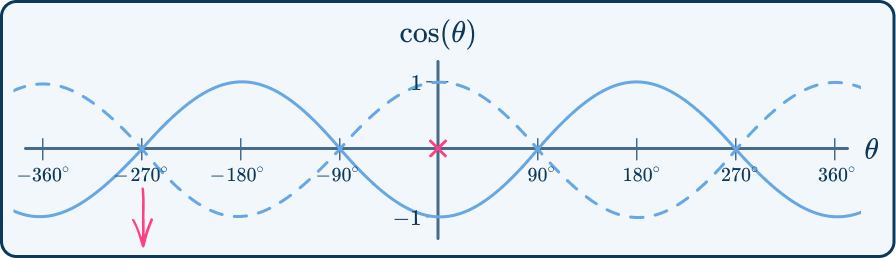
Rotational symmetry FAQs
Rotational symmetry is the number of times a shape can “fit into itself” as it is rotated 360^{\circ} about its center.
To find the order of rotational symmetry of a shape, identify the center of the shape, rotate the shape around its center, and count how many times the shape matches its original position in one full 360^{\circ} rotation.
Rotational symmetry involves rotating a shape around a center point to see if it looks the same; reflectional symmetry (or mirror symmetry) involves flipping the shape over a line (the line of symmetry) to see if it looks the same.
The next lessons are
- Angles in polygons
- Congruence and similarity
- Transformations
Still stuck?
At Third Space Learning, we specialize in helping teachers and school leaders to provide personalized math support for more of their students through high-quality, online one-on-one math tutoring delivered by subject experts.
Each week, our tutors support thousands of students who are at risk of not meeting their grade-level expectations, and help accelerate their progress and boost their confidence.

Find out how we can help your students achieve success with our math tutoring programs.
[FREE] Common Core Practice Tests (3rd to 8th Grade)
Prepare for math tests in your state with these 3rd Grade to 8th Grade practice assessments for Common Core and state equivalents.
Get your 6 multiple choice practice tests with detailed answers to support test prep, created by US math teachers for US math teachers!