High Impact Tutoring Built By Math Experts
Personalized standards-aligned one-on-one math tutoring for schools and districts
Radicals
Here we will learn about radicals, including simplifying radicals, adding and subtracting radicals, multiplying radicals, dividing radicals and rationalizing radicals.
Students are first exposed to a radical, or square root in 8 th grade when taking the square root of numbers. However, they greatly expand that knowledge in algebra class.
What are radicals?
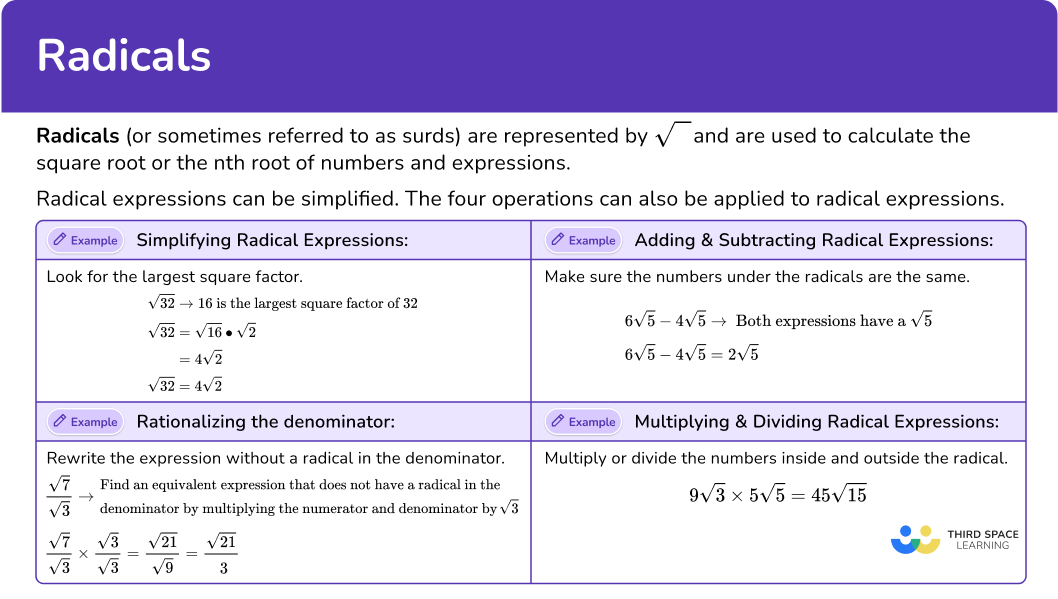
Radicals (or sometimes referred to as surds) are represented by \sqrt{\;\;} and are used to calculate the square root or the nth root of numbers and expressions. Expressions with \sqrt{\;\;} are called radical expressions.
For example, \sqrt{16}=4 because 16 is a perfect square number. Perfect square numbers have whole number roots.
However, \sqrt{5} \approx 2.23606 \ldots is an irrational number because it’s a non-terminating, non-repeating decimal that cannot be expressed as a fraction.
![[FREE] Algebra Worksheet (Grade 6 to 8)](https://thirdspacelearning.com/wp-content/uploads/2023/07/Algebra-check-for-understanding-quiz-listing-image-.png)
[FREE] Algebra Worksheet (Grade 6 to 8)
Use this quiz to check your grade 6 to 8 students’ understanding of algebra. 10+ questions with answers covering a range of 6th and 8th grade algebra topics to identify areas of strength and support!
DOWNLOAD FREE [FREE] Algebra Worksheet (Grade 6 to 8)
Use this quiz to check your grade 6 to 8 students’ understanding of algebra. 10+ questions with answers covering a range of 6th and 8th grade algebra topics to identify areas of strength and support!
DOWNLOAD FREESimplifying radicals and exact calculations
You can simplify the number under the radical to an exact calculation. For example, let’s apply the Pythagorean Theorem to find the missing length of the triangle.
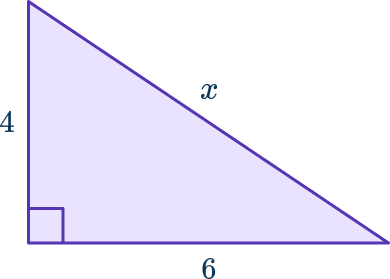
Notice how 52 is not a perfect square number. One way to find the answer is to type \sqrt{52} into a calculator.
Another strategy is to simplify the number under the radical. That means to find the largest square root factor of 52.
Here are some perfect square numbers: 4, 9, 16, 25, 36, 49, 64, 81, 100, 121, 144, 169, …
4 is the largest perfect square factor of 52.
\begin{aligned}& \sqrt{52}=\sqrt{4} \times \sqrt{13} \\\\ & \sqrt{52}=2 \times \sqrt{13} \end{aligned}\sqrt{52}=2 \sqrt{13} \rightarrow simplified radical expression or exact form
You can also simplify radical expressions that contain variables.
For example, let’s simplify the expression, \sqrt{4 x^3}
4 is a perfect square number so that is simple enough to do. However, how do you simplify x^3? Variables raised to even exponents are considered perfect square expressions.
\begin{aligned}& x^2=x \cdot x \\\\ & x^4=x^2 \cdot x^2 \\\\ & x^6=x^3 \cdot x^3\end{aligned}If you notice, x^3 does not have an even exponent. However, you can break it apart so that it does.
\begin{aligned}& \sqrt{4 x^3}=\sqrt{4 \cdot x^2 \cdot x}=\sqrt{4} \cdot \sqrt{x^2} \cdot \sqrt{x} \\\\ & =2 x \sqrt{x} \end{aligned}\sqrt{4 x^3} simplified is 2 x \sqrt{x}
Step-by-step guide: How to simplify radicals
Adding and subtracting radical expressions
In order to add and subtract radical expressions, the number or expression under the radical symbol must be the same.
For example, 14 \sqrt{6}-6 \sqrt{6} can be subtracted because both radicals are identical.
So, 14 \sqrt{6}-6 \sqrt{6}=8 \sqrt{6}
Do not add or subtract the number under the radical. It remains the same.
If the number or expression under the radical is not the same, you must use strategies for simplifying the radical in order to add or subtract them.
For example, 5 \sqrt{12}+2 \sqrt{27} cannot be added the way it is written because the radicals do not match.
\begin{aligned}5 \sqrt{12} & =5 \cdot \sqrt{4} \cdot \sqrt{3} \\\\ & =5 \cdot 2 \sqrt{3} \\\\ & =10 \sqrt{3} \\\\ 2 \sqrt{27} & =2 \cdot \sqrt{9} \cdot \sqrt{3} \\\\ & =2 \cdot 3 \sqrt{3} \\\\ & =6 \sqrt{3} \end{aligned}In this case, the radicals simplify to be the same. So, they can now be added.
10 \sqrt{3}+6 \sqrt{3}=16 \sqrt{3}Step-by-step guide: Adding radicals
Step-by-step guide: Subtracting radical
Multiplying and dividing radicals
Unlike addition and subtraction, the radicals do not have to match when multiplying or dividing. You can also multiply and divide the numbers under the radicals.
For example, 6 \sqrt{7} \cdot 9 \sqrt{2}=54 \sqrt{14} \rightarrow The numbers outside the radicals multiply together and the numbers under the radicals multiply together.
Always remember to look at the final product to see if it can be simplified. In this case, the product cannot be simplified any further because there is not a perfect square factor of 14.
Let’s look at another example. \cfrac{16 \sqrt{24}}{4 \sqrt{2}}=4 \sqrt{12}
When dividing, the numbers outside of the radicals can divide one another and the numbers inside the radicals can divide one another. In this case, notice how the quotient can be simplified.
\begin{aligned}4 \sqrt{12} & =4 \cdot \sqrt{4} \cdot \sqrt{3} \\\\ & =4 \cdot 2 \sqrt{3} \\\\ & =8 \sqrt{3}\end{aligned}Step-by-step guide: Multiplying radicals
Step-by-step guide: Dividing radicals
Rationalizing the denominator
Expressions that have radicals in the denominator must be rationalized. This means that an equivalent expression has to be created so that it does not have a radical in the denominator.
Let’s look at the expression \cfrac{\sqrt{15}}{\sqrt{6}}, notice how 6 does not divide evenly into 15.
So, division does not work in this case. The radical cannot remain in the denominator so there is another strategy you can use to rationalize the expression.
Multiply the numerator and denominator by the radical in the denominator, which is \sqrt{6}. The goal is to find an equivalent expression that does not have a radical in the denominator.
Multiplying the numerator and denominator by \sqrt{6} is like multiplying the expression by \cfrac{\sqrt{6}}{\sqrt{6}} which is 1.
\cfrac{\sqrt{15}}{\sqrt{6}} \cdot \cfrac{\sqrt{6}}{\sqrt{6}}=\cfrac{\sqrt{90}}{\sqrt{36}}=\cfrac{\sqrt{9} \cdot \sqrt{10}}{6}=\cfrac{3 \sqrt{10}}{6}\cfrac{\sqrt{15}}{\sqrt{6}}=\cfrac{3 \sqrt{10}}{6} \rightarrow the radical is no longer in the denominator
However, the expression \cfrac{3 \sqrt{10}}{6} can be simplified further. Notice how the 3 in the numerator and the 6 in the denominator can be simplified.
So, \cfrac{\sqrt{15}}{\sqrt{6}}=\cfrac{3 \sqrt{10}}{6}=\cfrac{\sqrt{10}}{2}
Step-by-step guide: Rationalize the denominator
What are radicals?
Common Core State Standards
How does this relate to high school math?
- Number and Quantity – High School: (HSN-RN.B.3)
Explain why the sum or product of two rational numbers is rational; that the sum of a rational number and an irrational number is irrational; and that the product of a nonzero rational number and an irrational number is irrational.
How to use radicals
There are lots of different ways we can calculate with radicals. We can:
- Simplify radicals and use them in exact calculations
- Add and subtract radical expressions
- Multiply and divide radicals
- Rationalize the denominator of radicals
Let’s have a look at each one in more detail.
Simplifying radical examples
Example 1: simplifying square roots
Simplify the expression: \sqrt{60}
- Find the largest square factor(s) of the term under the root.
Square numbers are 1, 4, 9, 16, 25, …
The largest square factor of 60 is 4 because 4 \times 15=60
2Rewrite the radical as a product of the square factor(s) and the other factors.
\begin{aligned}\sqrt{60} & =\sqrt{4 \times 15} \\\\ & =\sqrt{4} \times \sqrt{15}\end{aligned}
3Simplify the radical expression.
\sqrt{60} =\sqrt{4} \times \sqrt{15} \;\; (4 is a perfect square so take the square root of 4 to simplify )
\hspace{0.8cm} =2 \sqrt{15}
\sqrt{60} simplifies to be 2 \sqrt{15}
Example 2: simplifying algebraic expression
Simplify the expression: \sqrt{16 x^5}
16 is a perfect square and x^4 is the largest square factor of x^5.
\begin{aligned}\sqrt{16 x^5} & =\sqrt{16 x^4 x^1} \\\\ & =\sqrt{16} \times \sqrt{x^4} \times \sqrt{x^1}\end{aligned}
\begin{aligned} \sqrt{16 x^5}&=\sqrt{16} \times \sqrt{x^4} \times \sqrt{x^1} \\\\ & =4 x^2 \sqrt{x^1} \end{aligned}
\sqrt{16 x^5} simplifies to be 4 x^2 \sqrt{x}
Adding and subtracting radicals examples
Example 3: add with unlike radicals
Add the expressions: 2\sqrt{5}+\sqrt{45}
\sqrt{5} and \sqrt{45} are not the same.
\sqrt{5} cannot be simplified.
\sqrt{45} can be simplified because 9 is a perfect square factor of 45.
\begin{aligned} \sqrt{45}&=\sqrt{9} \times \sqrt{5} \\\\ \sqrt{45}&=3 \sqrt{5} \end{aligned}
Example 4: subtract with unlike radicals
Subtract the expressions: \sqrt{18}-10 \sqrt{2}
\sqrt{18} and \sqrt{2} are not the same.
\sqrt{18} can be simplified because 9 is a perfect square factor of 18.
\begin{aligned}\sqrt{18} & =\sqrt{9} \times \sqrt{2} \\\\ & =3 \sqrt{2}\end{aligned}
\sqrt{2} cannot be simplified
Multiplying and dividing radicals examples
Example 5: dividing radicals
Divide the radical expression.
\cfrac{2 \sqrt{10}-\sqrt{90}}{\sqrt{2}} \cfrac{2 \sqrt{10}-\sqrt{90}}{\sqrt{2}}
In this case, you are going to divide 2 \sqrt{10} \div \sqrt{2} and \sqrt{90} \div \sqrt{2}
So, 2 \sqrt{10} \div \sqrt{2}=2 \sqrt{5} and \sqrt{90} \div \sqrt{2}=\sqrt{45}
\sqrt{5} cannot be simplified.
\sqrt{45} can be simplified because 45 has a perfect square factor which is 9.
\begin{aligned}\sqrt{45} & =\sqrt{9} \times \sqrt{5} \\\\ & =3 \times \sqrt{5} \\\\ & =3 \sqrt{5}\end{aligned}
\sqrt{45} simplifies to be 3 \sqrt{5}
\begin{aligned}& \cfrac{2 \sqrt{10}-\sqrt{90}}{\sqrt{2}}=2 \sqrt{5}-\sqrt{45} \\\\ & \cfrac{2 \sqrt{10}-\sqrt{90}}{\sqrt{2}}=2 \sqrt{5}-3 \sqrt{5}\end{aligned}
In this example, you can go even further to simplify because the radicals in both terms match. So, 2 \sqrt{5}-3 \sqrt{5}=-1 \sqrt{5} or -\sqrt{5}
Example 6: multiplying radicals expanding brackets
Multiply the radical expression.
\sqrt{3}(6+\sqrt{8})In this case, you will have to use the distributive property.
\begin{aligned}\sqrt{3}(6+\sqrt{8}) & =\sqrt{3} \times 6+\sqrt{3} \times \sqrt{8} \\\\
& =6 \sqrt{3}+\sqrt{24}\end{aligned}
6 \sqrt{3}+\sqrt{24} \rightarrow \sqrt{3} cannot be simplified and \sqrt{24} can be simplified because 24 has a perfect square factor which is 4.
\begin{aligned}&\begin{aligned}
\sqrt{24} & =\sqrt{4} \times \sqrt{6} \\\\ & =2 \times \sqrt{6}\\\\ & =2 \sqrt{6} \end{aligned} \\\\ &\begin{gathered}6 \sqrt{3}+\sqrt{24}=6\sqrt{3}+2 \sqrt{6}\end{gathered}\end{aligned}
Rationalizing radical expressions examples
Example 7: rationalize the denominator
Simplify the radical expression.
\cfrac{\sqrt{5}}{\sqrt{12}}The radical in the denominator is \sqrt{12}.
So, \cfrac{\sqrt{5}}{\sqrt{12}} \times \cfrac{\sqrt{12}}{\sqrt{12}}=\cfrac{\sqrt{60}}{\sqrt{144}}
\sqrt{60} can be simplified further because 60 has a perfect square factor which is 4. So, \sqrt{60}=\sqrt{4} \times \sqrt{15} which simplifies to be 2 \sqrt{15}
\cfrac{2 \sqrt{15}}{12} can then be simplified further because 2 is a factor of 12.
\cfrac{2 \sqrt{15}}{12}=\cfrac{\sqrt{15}}{6}
\cfrac{\sqrt{15}}{6} is simplified completely.
Example 8: rationalize the denominator using the conjugate
Simplify the expression by rationalizing the denominator.
\cfrac{6}{\sqrt{11}-3}The conjugate of \sqrt{11}-3 is \sqrt{11}+3
\begin{aligned} &\cfrac{6}{\sqrt{11}-3} \times \cfrac{\sqrt{11}+3}{\sqrt{11}+3} \\\\ &=\cfrac{6 \times \sqrt{11}+6 \times 3}{\sqrt{11} \times \sqrt{11}+\sqrt{11} \times 3-(3 \times \sqrt{11}-3 \times 3} \\\\ &=\cfrac{6 \sqrt{11}+18}{\sqrt{121}-9} \\\\ &=\cfrac{6 \sqrt{11}+18}{11-9} \\\\ &=\cfrac{6 \sqrt{11}+18}{2} \end{aligned}\cfrac{6 \sqrt{11}+18}{2} can be simplified because 2 is a factor of 6 and 18
\cfrac{6 \sqrt{11}+18}{2}=9+3 \sqrt{11}
Teaching tips for radicals
- Reinforce perfect square numbers with students.
- Review with students how to break numbers down into their factors.
- Use digital platforms such as Desmos to help students develop conceptual understanding.
- Have students practice problems by using interactive digital platforms such as Khan Academy.
Easy mistakes to make
- Thinking that the square root is dividing a number by \bf{2}
For example, \sqrt{16}≠ 8
\sqrt{16}=4 because 4 \times 4=16
- Rewriting the number under the square root sign (the radicand) as a product of any two factors
In order to simplify a radical, it has to be a perfect square or has to have a perfect square factor. So, one of these factors must be a square number.
To simplify \sqrt{40} , break 40 so that one of the factors is a perfect square. The largest square factor of 40 is 4.
\begin{aligned}\sqrt{40} & =\sqrt{4} \times \sqrt{10} \\\\ & =2 \times \sqrt{10} \\\\ & =2 \sqrt{10}\end{aligned}
- Not simplifying fully
Always check that there are no square factors of the number under the root.
For example,
\begin{aligned}\sqrt{32} & =\sqrt{4} \times \sqrt{8} \\\\ & =2 \times \sqrt{8} \\\\ & =2 \sqrt{8}\end{aligned}
This expression is not fully simplified because the number under the radical, 8, can be simplified further. 4 is a perfect square factor of 8.
So, 2 \sqrt{8}=2 \times \sqrt{4} \times \sqrt{2}=2 \times 2 \times \sqrt{2}=4 \sqrt{2}
- Remembering that a radical or root with no integer coefficient is ‘ \bf{1} lot’ of that surd
As in algebra, we understand that a actually means 1a. So, \sqrt{2} means 1 \times \sqrt{2}
- Mixing up addition and multiplication laws
With addition, the radicals have to match and only the numbers in front of the radicals can be added \rightarrow \sqrt{3}+\sqrt{3}=2 \sqrt{3}
With multiplication, both the numbers inside and outside the radicals are multiplied together \rightarrow \sqrt{3} \times \sqrt{3}=\sqrt{9}=3
Refer back to knowledge of algebra to help: a+a=2 a and a \times a=a^2 \text {.}
- Trying to combine unlike radicals
For example, \sqrt{3}+\sqrt{5}≠ \sqrt{8} , just leave the expression as \sqrt{3}+\sqrt{5}
Practice radicals questions
1. Simplify the radical expression fully.
\sqrt{450}


Look for the largest perfect square factor of 450.
225 is a perfect square number and a factor of 450.
So,
\begin{aligned}\sqrt{450} & =\sqrt{225 \times 2} \\\\ & =\sqrt{225} \times \sqrt{2} \\\\ & =15 \sqrt{2} \end{aligned}
2. Subtract the radical expression.
\sqrt{50}-2 \sqrt{2}
Simplify the radicals so that the radicals of both terms match.
\sqrt{50} can be simplified. Rewrite \sqrt{50}=\sqrt{25 \times 2}=5 \sqrt{2}
Both radicals match so the terms can be subtracted.
5 \sqrt{2}-2 \sqrt{2}=3 \sqrt{2}
3. Multiply the radical expressions and simplify the answer fully.
\sqrt{7} \times 2 \sqrt{8}
Multiply the numbers inside the radicals and outside the radicals.
\sqrt{7} \times 2 \sqrt{8}=2 \sqrt{56}
\sqrt{56} can be simplified because 56 has a perfect square factor which is 4.
\begin{aligned}\sqrt{56} & =\sqrt{4} \times \sqrt{14} \\\\ & =2 \times \sqrt{14} \\\\ & =2 \sqrt{14}\end{aligned}
So,
\begin{aligned}2 \sqrt{56} & =2 \times 2 \sqrt{14} \\\\ & =4 \sqrt{14}\end{aligned}
4. Divide the radical expression and simplify the answer fully.
\cfrac{\sqrt{60}}{2 \sqrt{3}}
Divide the number under the radicals.
\begin{aligned}& \cfrac{\sqrt{60}}{2 \sqrt{3}} \rightarrow \sqrt{60} \div \sqrt{3}=\sqrt{20} \\\\ & \cfrac{\sqrt{60}}{2 \sqrt{3}}=\cfrac{\sqrt{20}}{2}\end{aligned}
Simplify the radical because 20 has a perfect square factor of 4.
\cfrac{\sqrt{20}}{2}=\cfrac{\sqrt{4} \times \sqrt{5}}{2}=\cfrac{2 \sqrt{5}}{2}=\sqrt{5}
5. Simplify the expression.
\sqrt{100 x^7}
\sqrt{100 x^7} can be simplified because 100 is a perfect square number.
\sqrt{x^7} can be rewritten as \sqrt{x^6 \times x} and x^6 is a perfect square term.
So,
\begin{aligned}\sqrt{100 x^7} & =\sqrt{100} \times \sqrt{x^6} \times \sqrt{x^1} \\\\ & =10 x^3 \sqrt{x}\end{aligned}
6. Expand the expression and simplify.
4(3+\sqrt{28})
Use the distributive property to multiply.
\begin{aligned}4(3+\sqrt{28}) & =4 \times 3+4 \times \sqrt{28} \\\\ & =12+4 \sqrt{28}\end{aligned}
\sqrt{28} can be simplified because 28 has a perfect square factor which is 4.
So, \sqrt{28}=\sqrt{4 \times 7}=2 \sqrt{7}.
\begin{aligned}12+4 \sqrt{28} & =12+4(2 \sqrt{7}) \\\\ & =12+8 \sqrt{7}\end{aligned}
So the final answer is 12+8 \sqrt{7}.
7. Rationalize the denominator of the radical expression.
\cfrac{4}{\sqrt{5}}
Multiply the numerator and denominator by \sqrt{5}.
Radical FAQs
A rational exponent is a fractional exponent that represents a radical expression. For example, the irrational number, \sqrt{3} can be written as (3)\frac{{1}}{{2}}.
When you get into algebra 2 you will learn how to work with the square root of negative numbers. The square root of negative numbers produce imaginary numbers.
The absolute value of a complex number is in the form of a+b i=\sqrt{a^2+b^2}.
You can take the cube root of perfect cube numbers similarly to the way you can take the square root of perfect square numbers.
For example, \sqrt[3]{8}=2. Notice how the index of the radical is 3, that’s because you are taking a cube root and not a square root.
Radical equations are equations that have radical expressions. Solving radical equations requires undoing the radical. For example, squaring a square root expression undoes the square root and cubing a cube root expression undoes the cube root.
In algebra 1 and algebra 2, you will analyze the graph of rational expressions/equations, logarithm equations, polynomial equations, quadratic equations, and linear equations. You will learn about their features and what their graphs look like.
The next lessons are
Still stuck?
At Third Space Learning, we specialize in helping teachers and school leaders to provide personalized math support for more of their students through high-quality, online one-on-one math tutoring delivered by subject experts.
Each week, our tutors support thousands of students who are at risk of not meeting their grade-level expectations, and help accelerate their progress and boost their confidence.

Find out how we can help your students achieve success with our math tutoring programs.
[FREE] Common Core Practice Tests (3rd to 8th Grade)
Prepare for math tests in your state with these 3rd Grade to 8th Grade practice assessments for Common Core and state equivalents.
Get your 6 multiple choice practice tests with detailed answers to support test prep, created by US math teachers for US math teachers!