High Impact Tutoring Built By Math Experts
Personalized standards-aligned one-on-one math tutoring for schools and districts
In order to access this I need to be confident with:
Algebraic expressions Integers Fractions Combining like termsSolving inequalities
Here you will learn about solving inequalities, including how to solve linear inequalities, identify integers in the solution set, and represent solutions on a number line.
Students will first learn about solving simple inequalities as part of expressions and equations in 6th grade math and expand that knowledge in 7th grade math.
What is solving inequalities?
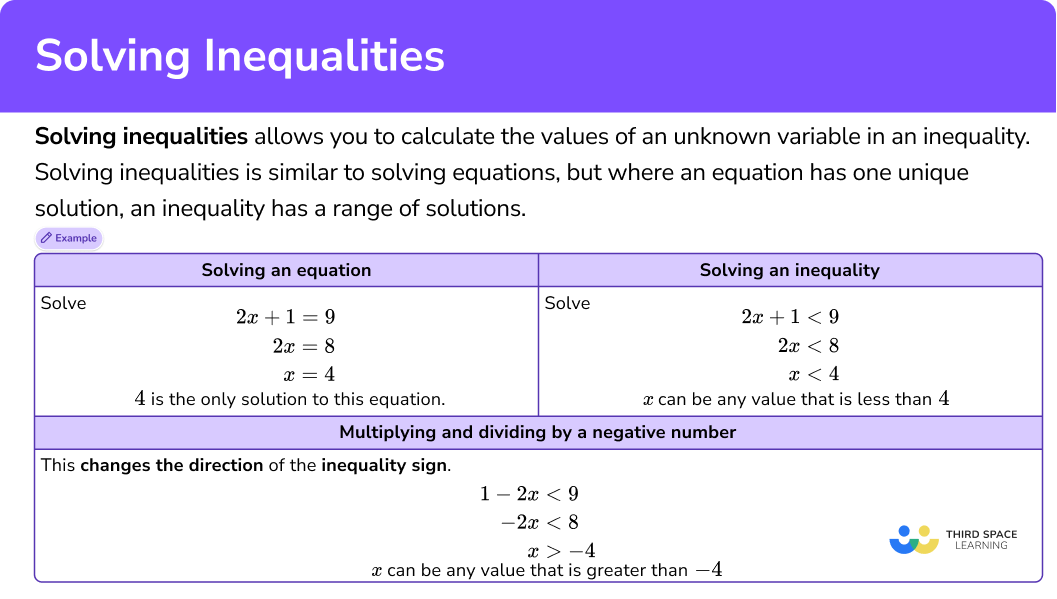
Solving inequalities allows you to calculate the values of an unknown variable in an inequality.
Solving inequalities is similar to solving equations, but where an equation has one unique solution, an inequality has a range of solutions.
In order to solve an inequality, you need to balance the inequality on each side of the inequality sign in the same way as you would balance an equation on each side of the equal sign. Solutions can be integers, decimals, positive numbers, or negative numbers.
For example,
| Solving an equation | Solving an inequality |
|---|---|
Solve \begin{aligned} 2x + 1 &= 9 \\ 2x &= 8 \\ x&= 4 \end{aligned} 4 is the only solution to this | Solve \begin{aligned} 2x + 1 &< 9 \\ 2x &< 8 \\ x&< 4 \end{aligned} x can be any value that is less
|
| Multiplying and dividing by a negative number |
|---|
This changes the direction of the inequality sign.
x can be any value that is greater than -4. |
What is solving inequalities?
![[FREE] Solving Inequalities Worksheet (Grade 7)](https://thirdspacelearning.com/wp-content/uploads/2024/02/Grade-6-to-8-Solving-Inequalities-Worksheet-listing-image.png)
[FREE] Solving Inequalities Worksheet (Grade 7)
Use this worksheet to check your 7th grade students’ understanding of solving inequalities. 15 questions with answers to identify areas of strength and support!
DOWNLOAD FREE [FREE] Solving Inequalities Worksheet (Grade 7)
Use this worksheet to check your 7th grade students’ understanding of solving inequalities. 15 questions with answers to identify areas of strength and support!
DOWNLOAD FREECommon Core State Standards
How does this relate to 6th grade and 7th grade math?
- Grade 6 – Expressions and Equations (6.EE.B.8)
Write an inequality of the form x > c or x < c to represent a constraint or condition in a real-world or mathematical problem. Recognize that inequalities of the form x > c or x < c have infinitely many solutions; represent solutions of such inequalities on number line diagrams.
- Grade 7 – Expressions and Equations (7.EE.4b)
Solve word problems leading to inequalities of the form px + q > r or px + q < r, where p, q, and r are specific rational numbers. Graph the solution set of the inequality and interpret it in the context of the problem.
For example: As a salesperson, you are paid \$50 per week plus \$3 per sale. This week you want your pay to be at least \$100. Write an inequality for the number of sales you need to make, and describe the solutions.
How to solve inequalities
In order to solve inequalities:
- Rearrange the inequality so that all the unknowns are on one side of the inequality sign.
- Rearrange the inequality by dividing by the \textbf{x} coefficient so that \textbf{‘x’} is isolated.
- Write your solution with the inequality symbol.
Solving linear inequalities examples
Example 1: solving linear inequalities
Solve:
4 x+6<26
- Rearrange the inequality so that all the unknowns are on one side of the inequality sign.
In this case you are subtracting 6 from both sides.
\begin{aligned} 4x+6&<26\\ 4x&<20 \end{aligned}
This leaves 4x on the left side of the inequality sign and 20 on the right side.
2Rearrange the inequality by dividing by the \textbf{x} coefficient so that \textbf{‘x’} is isolated.
In this case you need to divide both sides by 4.
\begin{aligned} 4x&<20\\ x&<5 \end{aligned}
This leaves x on the left side of the inequality sign and 5 on the right side.
3Write your solution with the inequality symbol.
x < 5
Any value less than 5 satisfies the inequality.
Example 2: solving linear inequalities
Solve:
5x-4 \geq 26
In this case you need to add 4 to both sides.
\begin{aligned} 5x-4&\geq26\\ 5x&\geq30 \end{aligned}
This leaves 5x on the left side of the inequality sign and 30 on the right side.
In this case you need to divide both sides by 5.
\begin{aligned} 5x&\geq30\\ x&\geq6 \end{aligned}
This leaves x on the left side of the inequality sign and 6 on the right side.
x\geq6
Any value greater than or equal to 6 satisfies the inequality.
Example 3: solving linear inequalities with parentheses
Solve:
3(x-4)\leq12
Let’s start by expanding the parentheses.
3x-12\leq12
Then you need to add 12 to both sides.
\begin{aligned}
3x-12&\leq12\\
3x&\leq24
\end{aligned}
This leaves 3x on the left side of the inequality sign and 24 on the right side.
In this case you need to divide both sides by 3.
\begin{aligned} 3x&\leq24\\ x&\leq8 \end{aligned}
This leaves x on the left side of the inequality sign and 8 on the right side.
x\leq8
Any value less than or equal to 8 satisfies the inequality.
Example 4: solving linear inequalities with unknowns on both sides
Solve:
5x-6 > 2x + 15
In this case you need to subtract 2x from both sides.
\begin{aligned}
5x-6&>2x+15\\
3x-6&>15
\end{aligned}
This leaves 3x-6 on the left side of the inequality sign and 15 on the right side.
In this case you need to add 6 to both sides.
\begin{aligned}
3x-6&>15\\
3x&>21
\end{aligned}
This leaves 3x on the left side of the inequality sign and 21 on the right side.
In this case you need to divide both sides by 3.
\begin{aligned}
3x&>21\\
x&>7
\end{aligned}
This leaves x on the left side of the inequality sign and 7 on the right side.
x > 7
Any value greater than 7 satisfies the inequality.
Example 5: solving linear inequalities with fractions
Solve:
\cfrac{x+3}{5}<2
In this case you need to multiply both sides by 5.
\begin{aligned}
\cfrac{x+3}{5}&<2\\
x+3&<10
\end{aligned}
In this case you need to subtract 3 from both sides.
\begin{aligned}
\cfrac{x+3}{5}&<2\\
x+3&<10\\
x&<7
\end{aligned}
x < 7
Any value less than 7 satisfies the inequality.
Example 6: solving linear inequalities with non-integer solutions
Solve:
6x+1\geq4
In this case you need to subtract 6 from both sides.
\begin{aligned}
6x+1&\geq4\\
6x&\geq3
\end{aligned}
In this case you need to divide both sides by 6.
\begin{aligned}
6x+1&\geq4\\
6x&\geq3\\
x&\geq\cfrac{3}{6}
\end{aligned}
This can be simplified to \, \cfrac{1}{2} \, or the decimal equivalent.
x\geq\cfrac{1}{2}
Any value greater than or equal to \, \cfrac{1}{2} \, satisfies the inequality.
Example 7: solving linear inequalities and representing solutions on a number line
Represent the solution on a number line:
2x-7 < 5
In this case you need to add 7 to both sides.
\begin{aligned} 2x-7&<5\\ 2x&<12 \end{aligned}
In this case you need to divide both sides by 2.
\begin{aligned}
2x-7& <5\\
2x& <12\\
x& < 6
\end{aligned}
x <6
Any value less than 6 satisfies the inequality. An open circle is required at 6 and the values lower than 6 indicated with an arrow.

Example 8: solving linear inequalities with negative x coefficients
Solve:
1-2x <7
In this case you need to subtract 1 from both sides.
\begin{aligned} 1-2x & <7 \\ -2x & <6 \end{aligned}
In this case you need to divide both sides by negative 2.
6 \div-2=-3
Because you divided by a negative number, you also need to change the direction of the inequality sign.
\begin{aligned} 1-2x & <7 \\ -2x & <6 \\ x &>-3 \end{aligned}
Example 9: solving linear inequalities and listing integer values that satisfy the inequality
List the integer values that satisfy:
3 < x+1\leq8
In this case you need to subtract 1 from each part.
\begin{aligned} 3&<x+1\leq8\\ 2&<x\leq7\\ \end{aligned}
2<x\leq7
2 is not included in the solution set. 7 is included in the solution set. The integers that satisfy this inequality are:
3, 4, 5, 6, 7
Example 10: solving linear inequalities and listing integer values that satisfy the inequality
List the integer values that satisfy:
7\leq4x\leq20
In this case you need to divide each part by 4.
\begin{aligned} 7\leq \, & 4x\leq20\\ \cfrac{7}{4}\leq & \; x \leq5 \end{aligned}
\cfrac{7}{4} \leq x \leq 5
\cfrac{7}{4} \, is included in the solution set but it is not an integer.
The first integer higher is 2.
5 is also included in the solution set.
The integers that satisfy this inequality are:
2, 3, 4, 5
Example 11: solving linear inequalities and representing the solution on a number line
List the integer values that satisfy:
-3<2x+5\leq7
In this case you need to subtract 5 from each part.
\begin{aligned}
-3<2x+5&\leq7\\
-8<2x&\leq2
\end{aligned}
\begin{aligned} -3<2x+5&\leq7\\ -8<2x&\leq2\\ -4<x&\leq1 \end{aligned}
-4<x\leq1
-4 is not included in the solution set so requires an open circle. 1 is included in the solution set so requires a closed circle.
Put a solid line between the circles to indicate all the values that satisfy the solution set.

Teaching tips for solving inequalities
- Students should master solving simple inequalities (one-step inequalities) before moving on to two-step inequalities (or multi-step inequalities).
- Foster student engagement by practicing solving inequalities through classroom games such as BINGO rather than daily worksheets.
- Student practice problems should have a variety of inequalities such as inequalities with fractions, negative numbers, and parentheses. (see examples above)
Easy mistakes to make
- Solutions as inequalities
Not including the inequality symbol in the solution is a common mistake. An inequality has a range of values that satisfy it rather than a unique solution so the inequality symbol is essential.
For example, when solving x + 3 < 7 giving a solution of 4 or x = 4 is incorrect, the answer must be written as an inequality x < 4 .
- Balancing inequalities
Errors can be made with solving equations and inequalities by not applying inverse operations or not balancing the inequalities. Work should be shown step-by-step with the inverse operations applied to both sides of the inequality.
For example, when solving x + 3 < 7 , adding 3 to both sides rather than subtracting 3 from both sides.
Related inequalities lessons
Practice solving inequalities questions
1. Solve:
3x+7 < 31


\begin{aligned} 3x+7&<31\\ 3x&<24\\ x&<8 \end{aligned}
2. Solve:
4x-3\geq25
\begin{aligned} 4x-3&\geq25\\ 4x&\geq28\\ x&\geq7 \end{aligned}
3. Solve:
2(x-5)\leq8
\begin{aligned} 2(x-5)&\leq8\\ 2x-10&\leq8\\ 2x&\leq18\\ x&\leq9 \end{aligned}
4. Solve:
6x-5 > 4x + 1
\begin{aligned} 6x-5&>4x+1\\ 2x-5&>1\\ 2x&>6\\ x&>3 \end{aligned}
5. Solve:
\cfrac{x-4}{2}>6
\begin{aligned} \cfrac{x-4}{2}&>6\\ x-4&>12\\ x&>16 \end{aligned}
6. Solve:
8x+1\geq3
\begin{aligned} 8x+1&\geq3\\ 8x&\geq2\\ x&\geq\cfrac{2}{8}\\ x&\geq\cfrac{1}{4} \end{aligned}
7. Represent the solution on a number line.
5x-2 < 28




\begin{aligned} 5x-2&<28\\ 5x&<30\\ x&<6 \end{aligned}
An open circle is required and all values less than 6 indicated.
8. Solve:
2-3x > 14
\begin{aligned} 2-3x &>14 \\ -3x &>12 \\ x &< -4 \end{aligned}
Change the direction of the inequality sign as you have divided by a negative number.
9. List the integer values that satisfy:
2<x+3\leq5
\begin{aligned} 2<x&+3\leq5\\ -1< \, &x\leq2 \end{aligned}
-1 is not included in the solution set as is greater than -1.
2 is included in the solution set as x is less than or equal to 2.
10. List the integer values that satisfy:
4\leq3x\leq21
\begin{aligned} 4\leq3&x\leq21\\ \cfrac{4}{3} \, \leq \, &x\leq7 \end{aligned}
The first integer greater than \, \cfrac{4}{3} \, is 2.
7 is included in the solution set as x is less than or equal to 7.
11. List the integer values that satisfy:
-4<3x+2\leq5
\begin{aligned} -4<3x&+2\leq5\\ -6<3&x\leq3\\ -2< \, &x\leq1 \end{aligned}
-2 is not included in the solution set as x is greater than -2.
1 is included in the solution set as x is less than or equal to 1.
Solving inequalities FAQs
Solving inequalities is where you calculate the values that an unknown variable can be in an inequality.
To solve an inequality, you need to balance the inequality on each side of the inequality sign in the same way as you would balance an equation on each side of the equal sign. Solutions can be integers, decimals, positive numbers, or negative numbers.
Solving inequalities is similar to solving equations, but where an equation has one unique solution, an inequality has a range of solutions.
The next lessons are
Still stuck?
At Third Space Learning, we specialize in helping teachers and school leaders to provide personalized math support for more of their students through high-quality, online one-on-one math tutoring delivered by subject experts.
Each week, our tutors support thousands of students who are at risk of not meeting their grade-level expectations, and help accelerate their progress and boost their confidence.

Find out how we can help your students achieve success with our math tutoring programs.
[FREE] Common Core Practice Tests (3rd to 8th Grade)
Prepare for math tests in your state with these 3rd Grade to 8th Grade practice assessments for Common Core and state equivalents.
Get your 6 multiple choice practice tests with detailed answers to support test prep, created by US math teachers for US math teachers!