Here we will learn about adding and subtracting algebraic fractions, including algebraic fractions with single and binomial denominators. We will also look at some problems involving quadratics and the difference of two squares.
There are also adding and subtracting algebraic fractions worksheets based on Edexcel, AQA and OCR exam questions, along with further guidance on where to go next if you’re still stuck.
What is adding and subtracting algebraic fractions?
Adding and subtracting algebraic fractions is the skill of adding and subtracting two or more fractions that contain algebraic terms.
For example, \cfrac{3}{2x+3}, \, \cfrac{5}{y^{2}} \, , \, or \, \cfrac{2ab}{3a+4b} \, .
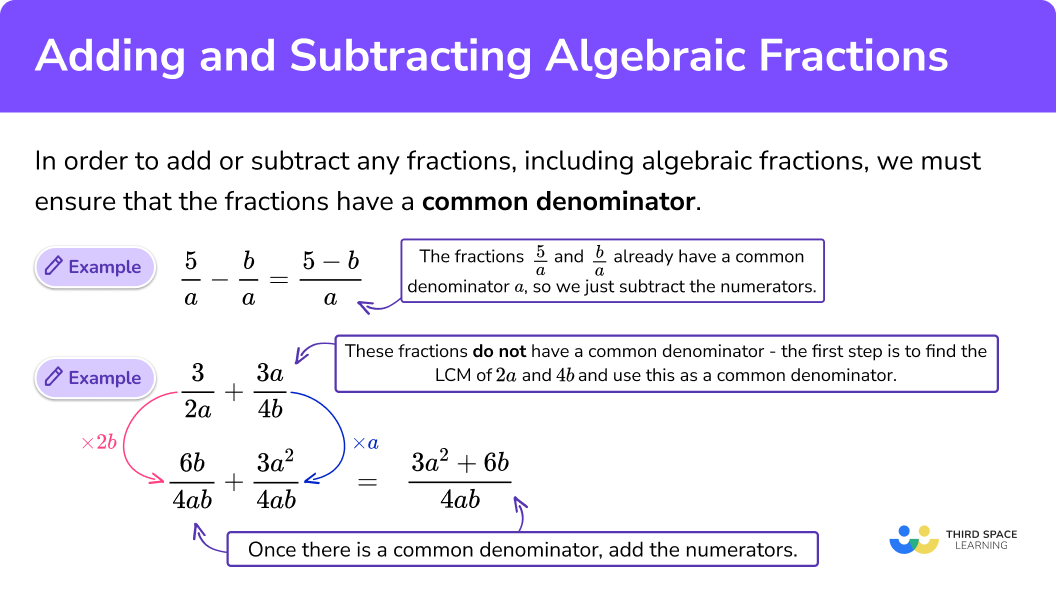
In order to add or subtract fractions we must ensure that the fractions have a common denominator.
For example, \cfrac{5}{2a^2} + \cfrac{c}{6ab} \, .
Finding the LCM of the algebraic denominators 2a^2 and 6ab using a Venn diagram.
2a^2 = 2\times a \times a
6ab = 2\times 3 \times a \times b
LCM = a \times 2\times a\times 3\times b =6a^{2}b
So the first denominator, 2a^2 , needs multiplying by 3b in order to make 6a^{2}b .
The second denominator, 6ab , needs multiplying by a in order to make 6a^{2}b .
Remember to multiply the numerator and denominator of a fraction by the same thing in order to write an equivalent fraction.
What is adding and subtracting algebraic fractions?
Fractions with a common denominator
If the fractions already have a common denominator then the numerators can be easily added/subtracted and the final answer will also have the same denominator. For algebraic fractions you may need to use additional skills such as simplifying expressions by collecting like terms.
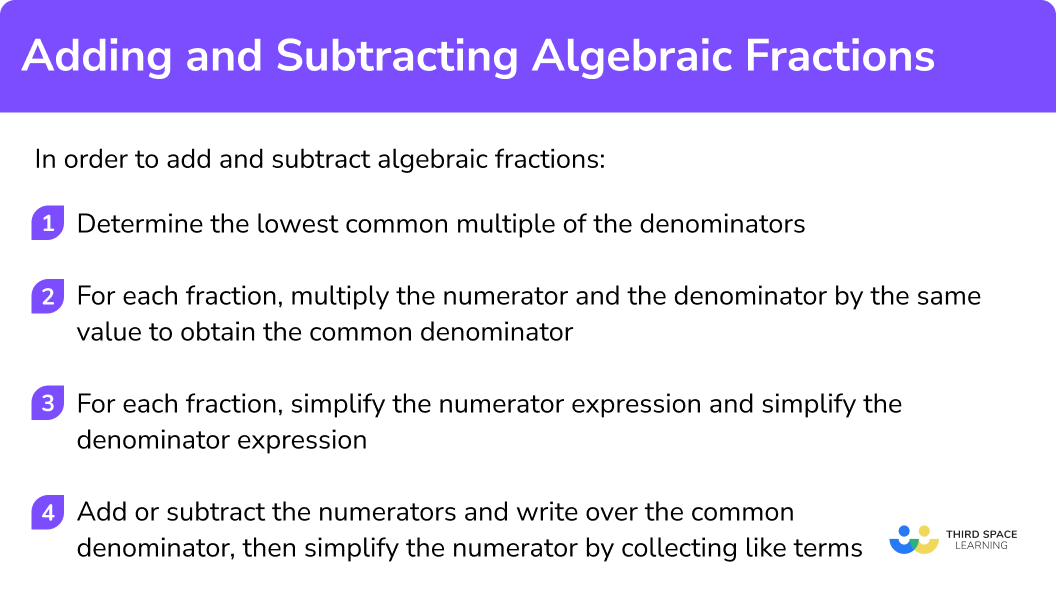
If the fractions have different denominators, we then need to find the lowest common multiple (LCM) of those denominators. Then we can use equivalent fractions to write all the fractions in the question with a common denominator.
Finding the LCM of numerical denominators will be a familiar skill. Additional skills such as expanding brackets and collecting like terms may be required for the algebraic numerators.
Finding the lowest common multiple of algebraic denominators can involve many different skills including identifying unique algebraic factors and factorising algebraic expressions.
Here are some examples of finding common algebraic denominators.
Find the LCM of monomial expressions. In order to work out the LCM of algebraic denominators with single terms (known as monomial expressions) you need to identify the common algebraic factors and the unique algebraic factors of each term.
You may also need to use the skill of finding the LCM of any numerical values involved. You then multiply together the – common algebraic factors – unique algebraic factors – numerical LCM to find the overall LCM for the algebraic terms.
For example,
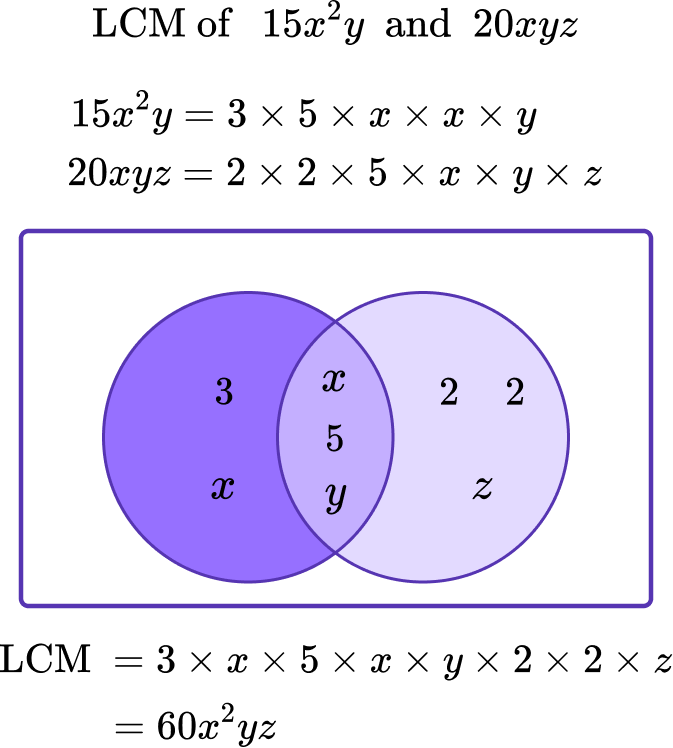
Using Venn diagrams to find the LCM It can also be helpful to use Venn diagrams to find the LCM of algebraic terms. First you need to write the algebraic terms as products of their factors (using prime factors for the numerical part of the term).
Then you put the factors into a Venn diagram, and the LCM will be the result of all the factors in the Venn diagram multiplied together.
For example,
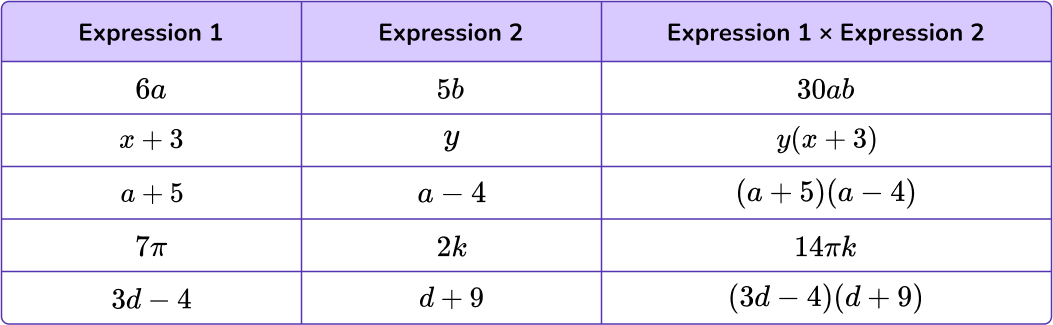
Multiply the denominators together to a common denominator Another technique to find a common denominator is to multiply the two denominators together.
This technique does not always find the lowest common multiple but does find a common multiple which can be used as the common denominator. This technique can be very useful when there are denominators with more than one term.
For example,
LCM of binomial and quadratic expressions Another technique for finding the LCM of algebraic denominators with more than one term is to factorise the expressions first. This can sometimes help to identify the LCM by highlighting common factors.
Get your free adding and subtracting algebraic fractions worksheet of 20+ algebraic fractions questions and answers. Includes reasoning and applied questions.
Get your free adding and subtracting algebraic fractions worksheet of 20+ algebraic fractions questions and answers. Includes reasoning and applied questions.
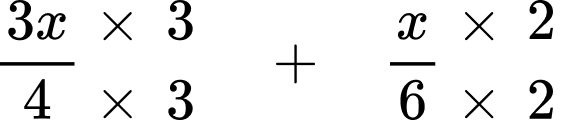
These are like terms so we can simplify this expression.
\cfrac{15x-14x}{21} \, =\cfrac{x}{21}
The final answer is \cfrac{x}{21} \, .
Example 5: adding algebraic fractions with numerical denominators
Write as a single fraction in the simplest form,
\cfrac{2x+1}{3} \, +\cfrac{x+2}{2} \, .
The lowest common multiple of 3 and 2 is 6.
Multiply the numerator and the denominator of the first fraction by 2.
Multiply the numerator and the denominator of the second fraction by 3.
Note: This will use skills such as expanding brackets, multiplying terms and collecting like terms. However, do not simplify the fraction by cancelling or dividing.
We have to think carefully at this point because the numerators have more than one term. We must remember to multiply all terms in the numerator by the identified value.
It can help to write each numerator in a single bracket before multiplying, like this,
\cfrac{2(2x+1)}{6} \, +\cfrac{3(x+2)}{6} \, .
By expanding the brackets, the numerator of the first fraction becomes 2(2x+1)=4x+2.
By expanding the brackets, the numerator of the second fraction becomes 3(x+2)=3x+6.
This gives us the updated calculation \cfrac{4x+2}{6} \, +\cfrac{3x+6}{6}.
Imagine that each numerator is within a single set of brackets.
When we add the numerators together (because the denominators are now the same), we get (4x+2)+(3x+6).
Expanding each bracket gives us the expression 4x+2+3x+6 which can be simplified to 7x+8 by collecting like terms.
\cfrac{(4x+2)+(3x+6)}{6} \, =\cfrac{7x+8}{6}
This step is important when subtracting fractions (see example 6).
The final answer is \cfrac{7x+8}{6} \, .
Example 6: subtracting algebraic fractions with numerical denominators
Write as a single fraction in the simplest form,
\cfrac{2x+1}{4} \, -\cfrac{x-1}{5} \, .
The lowest common multiple of 4 and 5 is 20.
Multiply the numerator and the denominator of the first fraction by 5.
Multiply the numerator and the denominator of the second fraction by 4.
Note: This will use skills such as expanding brackets, multiplying terms and collecting like terms. However, do not simplify the fraction by cancelling or dividing.
We have to think carefully at this point because the numerators have more than one term. We must remember to multiply all terms in the numerator by the identified value.
Writing each numerator in a single bracket before multiplying makes our calculation look like this.
\cfrac{5(2x+1)}{20} \, -\cfrac{4(x-1)}{20}
By expanding the brackets, the numerator of the first fraction becomes 5(2x+1)=10x+5.
By expanding the brackets, the numerator of the second fraction becomes 4(x-1)=4x-4.
This gives us the equivalent calculation \cfrac{10x+5}{20} \, -\frac{4x-4}{20}\, .
Imagine that each numerator is within a single set of brackets.
When we subtract the numerators, we get (10x+5)-(4x-4).
Expanding each bracket gives us the expression 10x+5-4x+4.
Notice how the last term has changed from - 4 to +4 .
This is because we must subtract each term that is in the second bracket. When you subtract negative four it is equivalent to adding four.
Simplifying this expression by collecting like terms gives us 10x+5-4x+4=6x+9.
\cfrac{10x+5-4x+4}{20} \, =\cfrac{6x+9}{20}
The final answer is \cfrac{6x+9}{20} \, .
We could also write \cfrac{3(2x+3)}{20} \, as our solution if we factorised the numerator.
Example 7: adding algebraic fractions where one fraction has a binomial denominator
Write as a single fraction in the simplest form,
\cfrac{5}{x} \, +\cfrac{2}{x+1} \, .
Sometimes the lowest common multiple can be found by simply multiplying the two denominators together. This is the case here.
The lowest common multiple of x and x+1 is x(x+1) which we can write as x\times{(x+1)} or x^{2}+x.
Top tip: Leave the denominator in its factorised form as this may help you simplify your solution at the end of the question.
Multiply the numerator and the denominator of the first fraction by (x+1).
Multiply the numerator and the denominator of the second fraction by x.
Note: This will use skills such as expanding brackets, multiplying terms and collecting like terms. However, do not simplify the fraction by cancelling or dividing.
The numerator of the first fraction becomes 5\times{(x+1)}=5(x+1)=5x+5.
The numerator of the second fraction becomes 2\times{x}=2x.
Note: By expanding the denominator, \cfrac{7x+5}{x^{2}+x} \, is also a valid solution.
Example 8: subtracting algebraic fractions where one fraction has a binomial denominator
Write as a single fraction in the simplest form,
\cfrac{3}{x+2} \, -\cfrac{6}{3x} \, .
Sometimes the lowest common multiple can be found by simply multiplying the two denominators together. This is the case here.
The lowest common multiple of x+2 and 3x is (x+2) \times 3x which we can write as 3x(x+2) or 3x^{2}+6x.
Remember it is often helpful to leave the denominator in its factorised form.
Multiply the numerator and the denominator of the first fraction by 3x.
Multiply the numerator and the denominator of the second fraction by (x+2).
Note: This will use skills such as expanding brackets, multiplying terms and collecting like terms. However, do not simplify the fraction by cancelling or dividing.
The numerator of the first fraction becomes 3\times{3x}=9x.
This gives us the fraction \cfrac{3x-12}{3x(x+2)} \, =\cfrac{3(x-4)}{3x(x+2)} \, .
The numerator and the denominator share a common factor of 3 and so we can cancel this factor.
\cfrac{3(x-4)}{3x(x+2)} \, =\cfrac{x-4}{x(x+2)}
This gives the final answer \cfrac{x-4}{x(x+2)} \, .
By expanding brackets, another form of the solution is \cfrac{x-4}{x^{2}+2x} \, .
Example 9: adding algebraic fractions where the denominators share a common binomial factor
Write as a single fraction in the simplest form,
\cfrac{5}{x+3}+\frac{1}{2x+6} \, .
When working with binomial denominators it is helpful to first see if they factorise. Here 2x+6 factorises to 2(x+3).
We can now see that the denominators share a common factor of (x+3) and the lowest common multiple is 2(x+3).
To write the fractions with a common denominator, we only need to multiply the numerator and the denominator of the first fraction by 2.
Note: This will use skills such as expanding brackets, multiplying terms and collecting like terms. However, do not simplify the fraction by cancelling or dividing.
The numerator of the first fraction becomes 5\times{2}=10.
The common denominator is 2(x+3).
This gives us the equivalent calculation \cfrac{10}{2(x+3)} \, +\cfrac{1}{2(x+3)} \, .
Example 10: adding algebraic fractions where both fractions have a binomial denominator
Write as a single fraction in the simplest form,
\cfrac{5}{x+2} \, +\cfrac{3}{x-2} \, .
Sometimes the lowest common multiple can be found by simply multiplying the two denominators together. This is the case here.
(x+2)\times(x-2)=(x+2)(x-2)
Remember you can leave the denominator in its factorised form.
Multiply the numerator and the denominator of the first fraction by (x-2).
Multiply the numerator and the denominator of the second fraction by (x+2).
Note: This will use skills such as expanding brackets, multiplying terms and collecting like terms. However, do not simplify the fraction by cancelling or dividing.
The numerator of the first fraction becomes 5\times{(x-2)}=5(x-2)=5x-10.
The numerator of the second fraction becomes 3\times{(x+2)}=3(x+2)=3x+6 \, .
The final answer is \cfrac{4(2x-1)}{(x+2)(x-2)} \, .
Example 11: subtracting algebraic fractions where both fractions have a binomial denominator
Write as a single fraction in the simplest form,
\cfrac{x}{x-2} \, -\cfrac{2x}{x+3} \, .
Sometimes the lowest common multiple can be found by simply multiplying the two denominators together. This is the case here.
(x-2)\times(x+3)=(x-2)(x+3)
Multiply the numerator and the denominator of the first fraction by (x+3).
Multiply the numerator and the denominator of the second fraction by (x-2).
Note: This will use skills such as expanding brackets, multiplying terms and collecting like terms. However, do not simplify the fraction by cancelling or dividing.
The numerator of the first fraction becomes x\times{(x+3)}=x^{2}+3x.
The numerator of the second fraction becomes 2x\times{(x-2)}=2x^{2}-4x.
The final answer is \cfrac{x(7-x)}{(x-2)(x+3)} \, .
Example 12: adding algebraic fractions with binomial denominators including the difference of two squares
Write as a single fraction in the simplest form,
\cfrac{x+5}{x^{2}-1} \, +\cfrac{3x-2}{x+1} \, .
The denominator of the first fraction is in the difference of two squares form. Factoring this expression gives us a pair of double brackets.
x^{2}-1=(x+1)(x-1)
Now we can see that the denominators share the common binomial factor of (x+1).
Therefore the lowest common multiple of (x^{2}-1) and (x+1) is (x+1)(x-1).
To write the fractions with a common denominator we only need to multiply the numerator and the denominator of the second fraction by (x-1).
Note: This will use skills such as expanding brackets, multiplying terms and collecting like terms. However, do not simplify the fraction by cancelling or dividing.
The numerator of the second fraction becomes (3x-2)(x-1)=3x^{2}-5x+2.
There is a chance that this fraction will simplify if we can factorise the quadratic numerator into a pair of double brackets and show that the numerator and denominator share a common binomial factor.
3x^{2}-4x+7 does not factorise.
The final answer is therefore \cfrac{3x^{2}-4x+7}{(x+1)(x-1)} \, .
Common misconceptions
Not recognising double negatives when subtracting algebraic fractions Some students fail to recognise the double negative when subtracting fractions in a question such as this.
\cfrac{2x}{7} \, -\cfrac{x-1}{7}
For example a student may incorrectly write the following working out.
In these steps the student has failed to subtract both of the terms of the numerator of the second fraction. To avoid this mistake it is advisable to write the numerators in brackets, as this helps to remind you that all the terms in the bracket need to be subtracted. The correct solution looks like this.
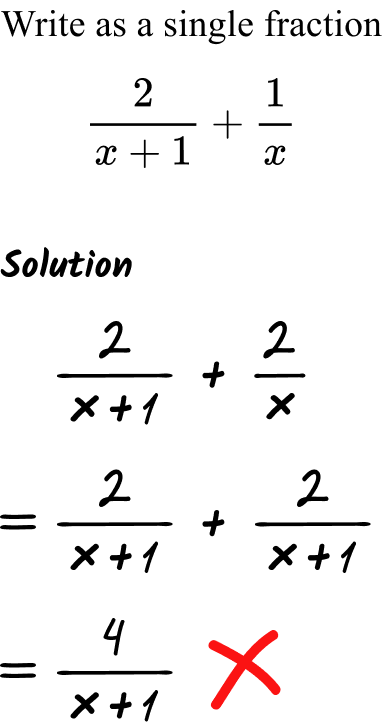
Adding or subtracting a value to the numerator and the denominator of a fraction in an attempt to write an equivalent fraction
To write an equivalent fraction we must multiply or divide both the numerator and denominator by the same value. Sometimes students incorrectly assume that they can do the same with addition or subtraction. For example, a student may incorrectly write the following working out.
The fraction \cfrac{3}{x} \, is not equivalent to \cfrac{3+1}{x+1} \, =\cfrac{4}{x+1} \, .
To avoid this mistake you must remember that you can only multiply or divide the numerator and denominator by the same value to write an equivalent fraction.
The lowest common multiple of the denominators in this question can be found by multiplying the denominators together (x)\times(x+1) = x(x+1). The correct solution looks like this.
Practice adding and subtracting algebraic fractions questions
1. Write as a single fraction in the simplest form,
Prepare your KS4 students for maths GCSEs success with Third Space Learning. Weekly online one to one GCSE maths revision lessons delivered by expert maths tutors.
We use essential and non-essential cookies to improve the experience on our website. Please read our Cookies Policy for information on how we use cookies and how to manage or change your cookie settings.Accept
Privacy & Cookies Policy
Privacy Overview
This website uses cookies to improve your experience while you navigate through the website. Out of these, the cookies that are categorized as necessary are stored on your browser as they are essential for the working of basic functionalities of the website. We also use third-party cookies that help us analyze and understand how you use this website. These cookies will be stored in your browser only with your consent. You also have the option to opt-out of these cookies. But opting out of some of these cookies may affect your browsing experience.
Necessary cookies are absolutely essential for the website to function properly. This category only includes cookies that ensures basic functionalities and security features of the website. These cookies do not store any personal information.
Any cookies that may not be particularly necessary for the website to function and is used specifically to collect user personal data via analytics, ads, other embedded contents are termed as non-necessary cookies. It is mandatory to procure user consent prior to running these cookies on your website.